Showing posts with label 2022-2023 School Year. Show all posts

Wednesday, June 7, 2023

Wrapping Up the 2022-23 School Year


The last time I posted here was last summer -- which means a whole school year has flown by! I thought I'd take the chance to share some highlights from the year before moving in to the next one.

But before I jump in: a few family updates...

This year, I had two in each Form: Gianna and Vincent in Form 5, Catherine and Xavier in Form 3, Bridget and Clara in Form 2, Andrew and Justin in Form 1 (and Damien and Emilia in Kinderleben!). It really worked out well having the students paired so neatly this year -- not only did it save me prep time, but my students always had someone to work with when desired.


And further, one thing I really like about the concept of Forms for the larger family is that although students are combined, students aren't forever paired with the same sibling. Depending on the year, they are sometimes with younger siblings, sometimes with older siblings; sometimes they are the youngest in a Form, and sometimes the oldest. I find this annual adjustment helps keep the dynamics fresh and gives the students a chance to strengthen different skills.

The other big family update this year: Baby Matthew Campion! Preparing for and recovering from his arrival was certainly a big part of our homeschool. He arrived the day before Epiphany.


So I planned a very light third term for Forms 1 and 2 and a semi-light term for Form 3. My high schoolers were bascially able to go back to their full schedule after our couple weeks off together. Even with a rocky postpartum time, we ended our school year on strong footing thanks to the CMEC, my wonderfully helpful husband, and rails of habit laid down over the past decade.


That said, I was SUPER relieved to head into summertime! It's so nice to have a break from juggling baby and lessons. Matthew is now five months old -- rolling, babbling, and starting to sleep through the night. And by the time we begin school again in August, he'll be napping more predictably, which will be a huge help!

On to the recap! It wasn't a perfect year by any means, but at the CMEC, we always like to take stock of signs of definite progress and celebrate our "wins." So I thought I'd share here five things that went really well this past year...

Studying history collaboratively and comparatively.

This year we studied roughly 1780-1900 (for all Forms) and Ancient Rome (for Form 2A and up). 

First: I love that my students are all studying the same time periods. It makes my mental workload much simpler and I feel like I can really "live" in the eras as a teacher of many grades.

Second, I'm grateful for fantastic books! American history was fascinating in all the books we read this year -- Builders of Our Country, This Country of Ours, and The Oxford History of the American People. Each one was rich and engaging for the age group it was aimed at. My Form 1 boys were sad for each chapter in Builders to end, and I often heard my high schoolers laugh out loud at Morison's witty, pointed insights. British history was great too: it's hard to beat Arnold-Forster!


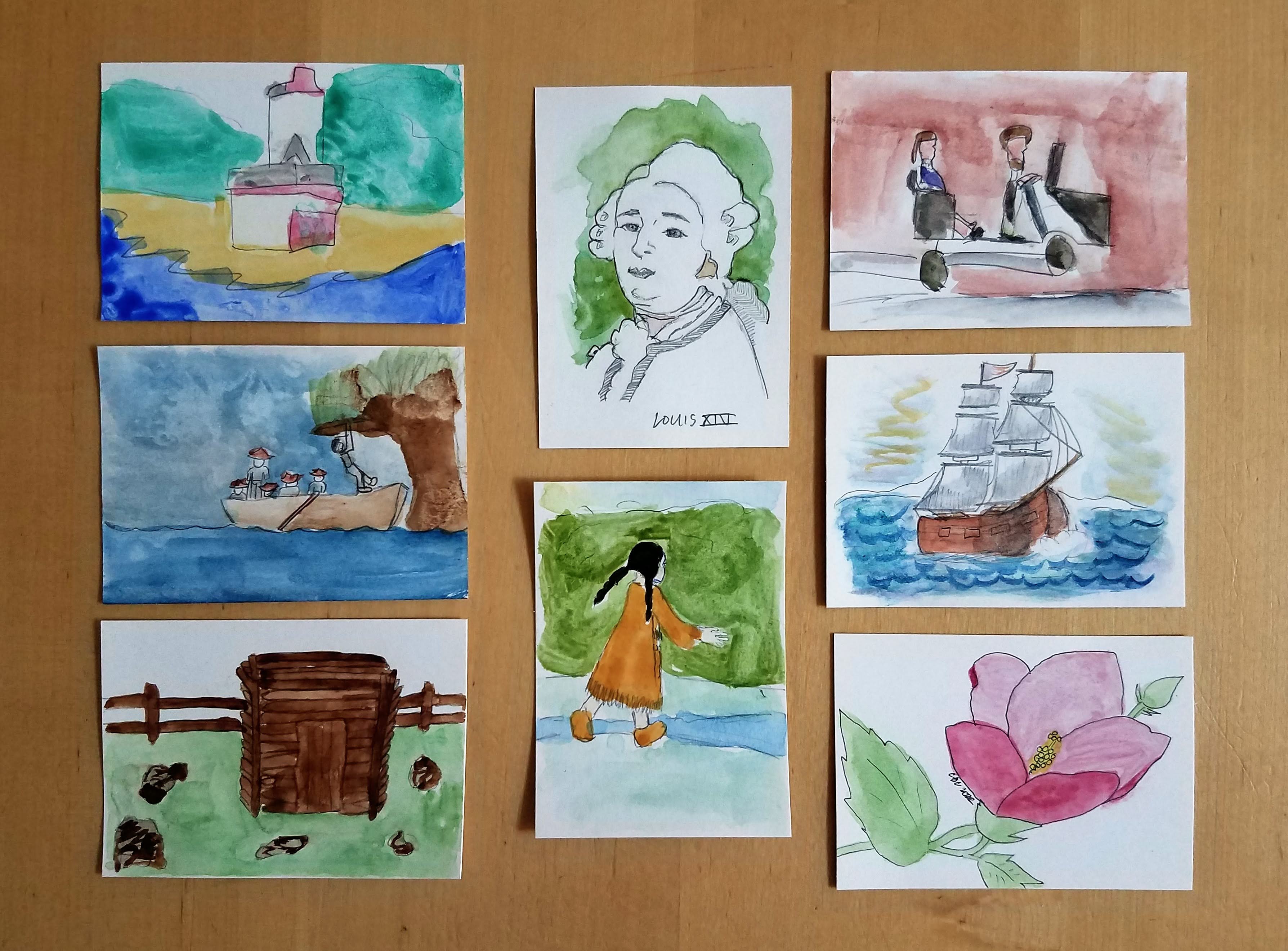
And although it was interesting last year reading about the founding of the American government alongside Ancient Greece, I was surprised to find so many connections this year between the Civil War and Ancient Rome. Comparative history makes for rich studies and lots of good history notebook work.

Using the high schoolers' literature as my own leisure reading.

I have talked so much here about pre-reading as schole and teaching with the posture of a student that it is likely cliche! But pregnancy/postpartum meant limited prep time for me this year, and the only leisure reading I really did was my kids' books (plus some Agatha Christie over Christmas break!). Particular favorites for me were Uncle Tom's CabinSilas MarnerA Tale of Two CitiesOedipus and AntigoneSesame and Lilies, and the poetry of Gerard Manley Hopkins. 

I am grateful my teacher prep can also be so enriching.

Participating in our Charlotte Mason-style co-op.

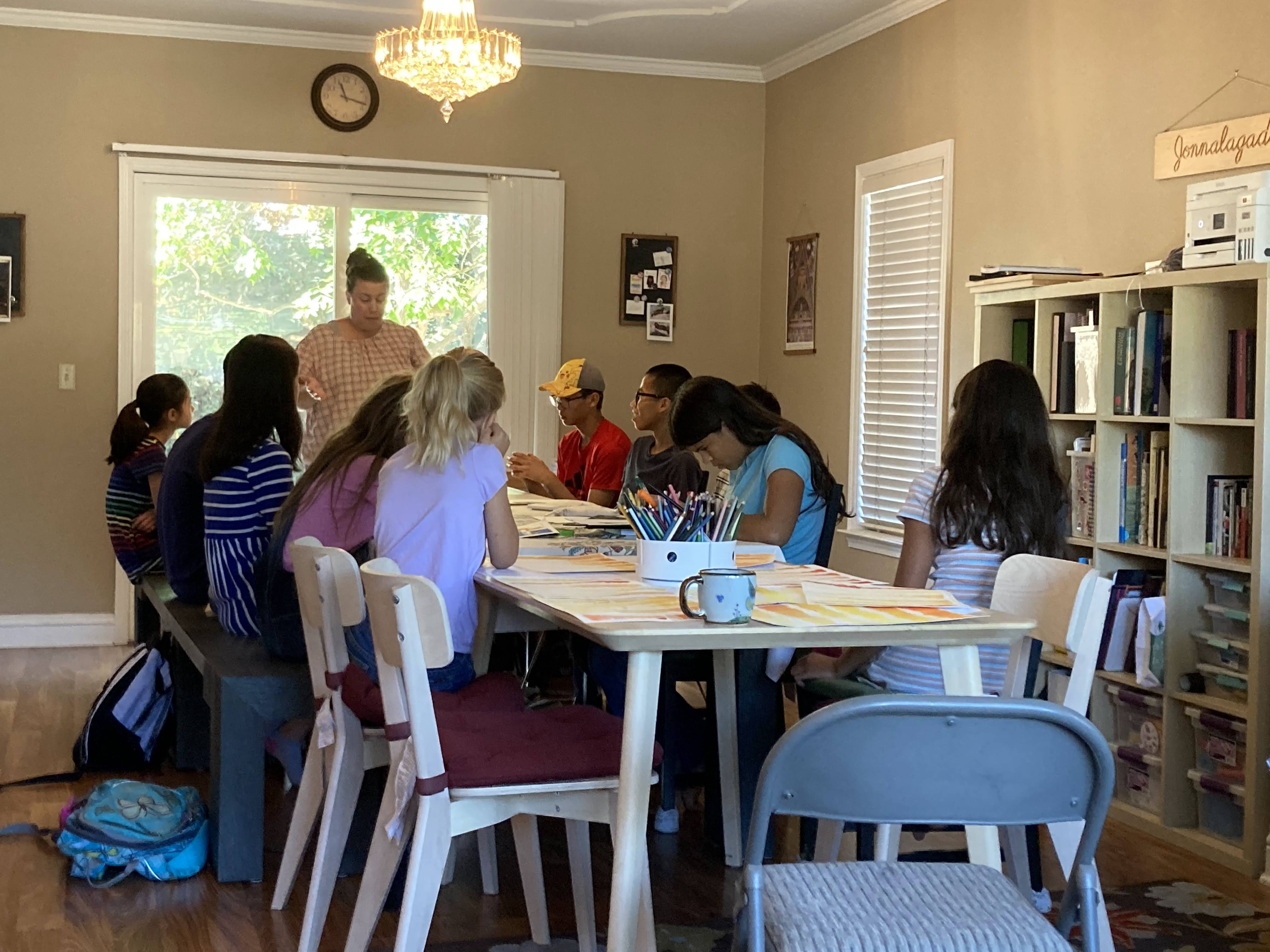
Last year was our first year with an academic co-op and not just a nature study club. (You can read about our fall term and spring term.) We continued with the same families this year and the CMEC as our guide, but took it indoors this year -- my friend hosted us in her home. Just like last year, we took up a different set of subjects each term and swapped teaching duties. Our spring term also looked quite different because instead of meeting every other week, we met for seven weeks in a row (with a couple weeks off in the middle for Easter). This allowed us to start a bit later (I was on a postpartum break) but still end on time and still meet for six meetings plus our end-of-term celebration. It has been so nice to take up different parts of the "feast" together.


It was a lovely year together. So many subjects: Plutarch, heraldry, choir, The Trumpet of the Swan, music theory, hymns and folksongs, recitation, architecture, folk dancing, singing games, chalk drawing, solfege, drill, brush drawing, and more! In the fall, we included a moms' time to meet and discuss a Parents' Review article while the kids played, which was really nice as well. 
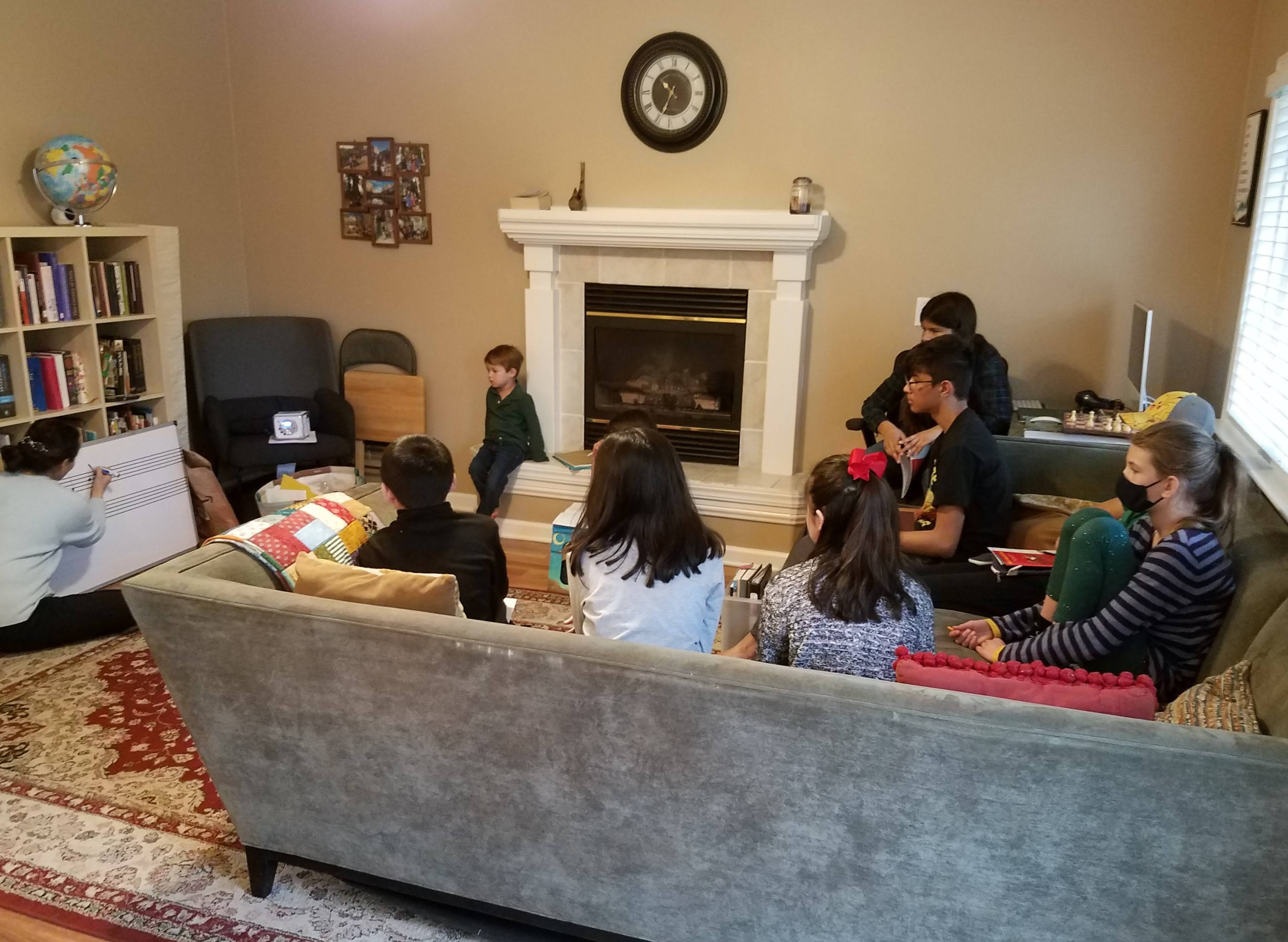


I love teaching the kids -- I think all of us do! And I am grateful to have found committed, kind, and thoughtful moms to partner with. They have become dear friends.


Outsourcing subjects to my older kids.

Isn't it wonderful when your children surpass you in skills?! My high school daughter's Italian is now much better than mine, and my middle school daughter is excellent at needlework, so I paid them this year to teach their younger siblings.

For Italian: It was time to break up my Form 1-3 students into two groups for Italian. Last year, I taught everyone together twice a week and then taught the Form 3 students an additional weekly block or two for Italian dictation, copywork, and grammar. This year, Gianna offered to teach the older three kids and I taught the younger three students. Lessons went much more smoothly (smaller groups, everyone working at an appropriate level) and teaching just the littles was really enjoyable for me.

For handicrafts: Catherine used the CMEC's needlecraft course over the year to help her younger siblings learn new stitches and complete a variety of projects. In addition to teaching the 30-minute weekly block on the schedule, she was responsible for letting me know what supplies were needed, assigning each student "homework" to work on over the week, and helping them with that homework as needed. This set up worked so well that she is continuing with the three younger boys (ages 8, 7, and 5) over the summer.


We are planning to continue this arrangement next year too -- I am trying to take advantage of the help before Gianna graduates and I lose one of my "team teachers." :)

Preparing postpartum timetables for an easier transition.

This one was on the advice of a dear friend. I had thought I might just play it by ear after the baby arrived, taking it as easy as needed and eventually scaling up to our regular timetable bit by bit. A friend who knows me better than I know myself (ha!) convinced me that putting the time in before baby arrived to create a super-light timetable for our postpartum term would lead to smoother days and a more restful term. And it would give me an excuse to truly take it easy and not try to get back to regular lessons just so we could have a plan to follow.

I actually made two light timetables: one that was really bare bones (basically just readings and Common Subjects), and one that added back in math and a couple other subjects as well. 

We ended up taking two weeks fully off before starting Term 3, then following our bare-bones timetable for six weeks and our other light timetable for the last few weeks of the term. I had planned to get back to our full schedule by the end of the year, but that didn't happen -- I needed more time to recover. And I was completely fine with that, since I had a great plan for the family that made sure we still sampled a wide feast.

So that's some wins from our year! A few more photos from our 22-23 studies to wrap up...

final Plutarch project for co-op

clay work from model

sweet Burgess narration

we loved studying Millais!

geography with Form 1

grammar review with Form 2 and 3 kids

Form 1 Buckley notebook work

Form 2 written narration

one week of Weekly Paintings

And now -- I'm deep in planning for the fall! I'll be adding a formal student (Damien will be in Form 1B) and will have two seniors, so it promises to be a year full of first, lasts, and excitement!

So what were the "wins" from your year -- favorite books or subjects, best tips, things you loved about your homeschool?

Thursday, July 21, 2022

Catholic History and Religion :: 2022-2023 School Year

Thanks for your patience as I put this annual post together!

Here I'm offering some suggestions for books that tie to the 1780-1900 time period we are studying this year in American, English, and world history (as well as a few for ancient Rome, our focus for ancients!) and additional resources for our regular Bible and religion studies.

This year, I am assigning Catholic reading for eight formal students: two in Form 5 (11th graders), two in Form 3 (7th grader and 8th grader), two in Form 2 (4th grader and 5th grader), and two in Form 1 (1st grader and 3rd grader). Once again, we will be using the CMEC mostly as written for all Forms.

This post is organized in the following way: (1) Bible for all Forms, (2) Historical Supplements for Forms 1-3, (3) Religion for Forms 1-3, and then (4) Catholic History and Religion for High School at the end.

Previous' years plans:

Catholic History and Religion :: 2020-2021 School Year

Catholic History and Religion :: 2021-2022 School Year

~~~

BIBLE

Lower Forms

For Old Testament, my students in Form 1-3 will be reading Joshua and Judges. As I have explained before, the CMEC follows the PNEU in scheduling Paterson-Smyth's books as a resource for Bible lessons, and I use his Joshua and the Judges for my preparation as well. I like to take his suggestions and combine with Catholic resources, so I rely on Knecht's A Practical Commentary on Holy Scripture too. This tome (it's a thick one!) provides a Catholic perspective on both Old and New Testaments, from historical background to theological and doctrinal connections to application. I have used it in various ways over the past few years and always with good results. It also includes a few nice images and diagrams helpful for Book of Centuries work.

For New Testament, my students in Forms 1 and 2 will read the Gospel of Luke. Paterson-Smyth doesn't have a commentary for this Gospel, so I will be using the Navarre commentary (lots of affordable used copies!), which comes on the recommendation of good friends.

Upper Forms

For New Testament, my high schoolers will be reading through Psalms and Proverbs this year with a few commentary resources on hand:
  • Dummelow's One-Volume Bible Commentary - We used this PNEU-recommended commentary last year and my kids liked the historical details it includes on each book. (This is the new edition -- we have an older used one.)
  • For Psalms: Commentary on the Psalms by St. Robert Bellarmine (I got an affordable used copy). I looked at a few different psalms commentaries from the saints and this was the one I thought my students would most enjoy. He does not provide much  historical background or concordance with other areas of scripture, instead giving thorough explications for each psalm. I think my students will appreciate his perspective.
  • For Proverbs: I have printed a few different texts from online resources, including Father Most's commentary at Catholic Culture.
My Form 3-5 students will also have two streams of New Testament reading: 

First, they'll be reading the gospels alongside Charlotte Mason's Saviour of the World.

Second, they'll be completing their two-year study of Acts this year alongside Ellen Knox's The Acts of the Apostles. This is not a Catholic commentary and includes comments we disagree with here and there, but I have been reading it alongside my students and it has made for good discussions. I described this book last year as well, but just for reference:

This PNEU book happens to be written by the aunt of Ronald Knox, author of The Creed in Slow Motion and The Mass in Slow Motion, two favorite books around here! Here's how my friend Kyndra explains the connection: 

Monsignor Knox' father was the Anglican Bishop of Manchester and a staunch evangelical (so staunch in fact that he cut his son out of his will upon his conversion to Catholicism). One of Monsignor Knox' brothers was an influential Anglo-Catholic priest who never could quite make the move to Rome. Both men were influenced by John Ruskin. Monsignor Knox was a friend of G.K.Chesterton and Frances Chesterton was the first secretary of Charlotte Mason's PNEU! Some of the best and brightest minds of late nineteeth/early twentieth century Britain and they all knew one another....

All Forms

In all our Bible lessons, we will be reading directly from our favorite translation, the Douay-Rheims. Each of my Upper Forms students has his or her own copy to use, and I use mine for the younger kids. 

We rely often on The Dore Bible Illustrations. I have used this volume for years and it so handy to have these scenes so reverently and beautifully illustrated all in one place!

As a side note: our TBG Songbooks from Riverbend Press include the Bible passages for the year in the King James Version, so I print ours in the Douay-Rheims and tape it in for our recitations. And for the terms that schedule a hymn we have already covered, we will work on reciting the additional verses of that hymn but also add in a Latin hymn to learn.

~~~


CATHOLIC HISTORICAL SUPPLEMENTS FOR FORMS 1-3

This coming year, we will be studying roughly 1780-1800 (beginning with the French Revolution through Reconstruction after the Civil War). My Form 2A and 3 students will also be studying Ancient Rome.

Form 1

My Form 1 students will read a couple easier saint biographies from the list below or from our collection of Windeatt books for this time period, including The Miraculous Medal (on Catherine Laboure), The Little Flower (on St. Therese), The Cure of Ars (on John Vianney), Pauline Jaricot. (The last two are longer and would be fine for Form 2 as well.) When they come around to this period again in Form 2 or 3, they will have the chance to read the others.

Forms 2 and 3

Most of these are from the Vision series or the American Background Series being reprinted by Hillside Education. This isn't an exhaustive list -- just what we have on our shelves, in no particular order. My students and I will pick 1-2 for them to read each term on Sundays. The others will go on the free reading shelf. (Form 3 students who are strong readers may also like some of the options under High School as well.)

Other Notes on Form 1-3 History

Arnold-Forster's A History of England and H.E. Marshall's Our Island Story are both written from a British, Anglican perspective. I love the books and think they are certainly worth using! I can't really imagine our homeschool without them. However, I do generally edit here and there and supplement with Catholic reading as described above for a more balanced view. With this approach, I think my students get to understand how the viewpoint of the author colors his or her work.

This year's assigned chapters don't need to be adjusted at all in my view, though. The only time they discuss Catholics is when describing the Catholic Emancipation Act in England, which is presented in both texts as a positive move toward justice.

The same can be said for our American history texts this year, This Country of Ours and Builders of Our Country, Volume 2.

~~~


RELIGION FOR FORMS 1-3

Catechetical Instruction and Sacramental Prep

My two Form 1 students just received First Holy Communion last month! (You can read about my FHC preparation plans here and here.) So they are very fresh on the basics and are ready for further study.

This year, I plan to spend a half hour with my Form 1 and 2 students each week in a study of the Mass. I will be using the following resources from our shelves:

And as a side note: I have been previewing lately a few new texts about the Traditional Latin Mass to see if they are worth recommending. I get asked for books about the TLM for children a lot and I always like to have a few good in-print and affordable recommendations to pass along! A couple new ones on our shelves are Traditional Latin Mass: A Missal for Little Ones and A Beginners Guide to the Traditional Latin MassIt's nice when discussing the mass structure to have various depictions of Low and High Mass to compare as well as different prayers for the different parts of the Mass to explain their overall role in the liturgy.

We will also be practicing with the hand missal -- this is my fave for littles, but the kids who just received FHC will be moving on to proper missals soon!

(For more titles for young children, I recommend a bunch here (listed under "For My Younger Kids"). I would also add to that list Leading Little Ones to Mary and The Secret of Mary Explained to Children, which I read with my littles last year.)


My Form 3 students will be preparing for Confirmation this year. (My older daughter will likely go through her prep in just one year. I may stretch my son's to his two years of middle school.) Here are the resources they will be using:


Spiritual Reading

My Form 1 and 2 students will be studying with me on Sundays, as mentioned above.

My Form 3 students will read a book a term for additional Sunday reading:
As a family, we will finish up our re-read of Mother Loyola's First Communion and then we may just start back up from the beginning again!

Liturgical Year (read as a family)

This year, we will continue A Character Calendarwhich has been a favorite with my younger students.  I will also do some season-specific family reading. We may go back to the Troadec volumes, which we used on and off last year, or we may try something different before Advent arrives. I personally find Mother Loyola's "With the Church" series much richer than Troadec's, but the simplicity of Fr. Troadec does make it accessible to a broader range of ages.

I read these at breakfast time, so my older kids listen in too. Many of the mottoes from A Character Calendar have found their way into my students' Motto Books!

~~~


CATHOLIC HISTORY AND RELIGION FOR FORM 5 (HIGH SCHOOL)

As always, please preview the books listed below before handing to your high schoolers.

Catholic Historical Supplements

The CMEC's high school history texts, which are written from a secular perspective, are quite nuanced and well-balanced, so I find our additional reading on Catholic-specific persons and events more than rounds out the period for my students.

I add a weekly Catholic history block to my high schoolers' timetable. Here's what will fill that slot this year:

I also like to schedule some Catholic literature or historical fiction. Some selections for this year:
  • Gertrude von le Fort's Song of the Scaffold (a thought-provoking novella what provides a new perspective on the French Revolution)
  • Sienkiewiczk's Quo Vadis (to connect to our Ancient Rome studies since my kids have already read Ben Hur, which is assigned by the CMEC this year)
  • Willa Cather's Death Comes for the Archbishop (assigned by the CMEC in Term 3)
  • Poetry of Gerard Manley Hopkins and Francis Thompson (assigned by the CMEC in Term 3)
  • Benson's The Necromancer (We have enjoyed Msgr. Benson's books before and this one is set in the Victorian period. I have read it's an argument against spiritualism and has some scary moments! I definitely need to pre-read first, but thought I would mention here in case you were interested too.)

Religion

For the older kids, I have assigned a bunch of books in various categories. These will be for daily devotional reading, Sunday reading, and leisure reading.

Spiritual classics written during the period:

Saint biographies and autobiographies:

Devotional reading through the year, not tied to this year's studies:

My kids also wanted some purely catechetical reading, so I went ahead and ordered the classic Fr. Laux's Catholic Morality and Catholic Apologetics for them to work through on Sundays as well. We'll see how far they get!

~~~

I hope this helps those studying this time period with us this fall!

Any wonderful books I should add to the list above? Let me know in the comments!

(Amazon links above are affiliate links. Thanks for your support!)