Sunday, August 23, 2026

Catholic History and Religion :: 2026-27 School Year


Excited to share here my annual post of recommendations for books on Catholic history, literature, and religion tied to the time period we will be studying with the CMEC this year: roughly 1780-1900 in American and British/European history, alongside ancient Rome.

For previous years' recommendations, check out my Catholic History and Religion archive. At this point, I have written posts every era! I have shared about this period before, but I have reorganized and refreshed my previous suggestions here and added a few new ones.

This post is organized into the following categories: Bible for all Forms, Catholic Historical Supplements for Forms 1-3, Religion for Forms 1-3, and Catholic Historical Supplements and Religion for Forms 4 & 5 (High School).

BIBLE

Lower Forms

The CMEC follows the PNEU in scheduling Paterson-Smyth's books as a complementary resource for Bible lessons, and I will be using them in my preparation as well. I don't agree with everything Paterson-Smyth writes, but he offers good "captain ideas" for Bible lessons that get at the overarching themes of the assigned Bible texts.

I like to take his suggestions in light of Catholic thought, so I rely on Knecht's A Practical Commentary on Holy Scripture as well. This tome provides a Catholic perspective on both Old and New Testaments, from historical background to theological and doctrinal connections to application. It also includes nice images and diagrams helpful for our Book of Centuries.

I will also be using these two references in preparing to go through the Gospel of Matthew and the prophets and kings of the Old Testament with my Form 1 & 2 students.

Upper Forms

For Old Testament, Form 3-5 students will be reading through Jeremiah and then some of the minor prophets this year. We have the following commentaries on hand:
  • Dummelow's One-Volume Bible Commentary - This PNEU-recommended commentary has a good amount of historical details for each book. (This is the new edition -- we have an older used one.)
  • Navarre's Major Prophets and Minor Prophets have served my older kids well throughout their Old Testament studies.
For New Testament reading, they'll be working through the Gospel of St. John. This was a special request from my senior daughter. For commentary, they have the Navarre and Thomas Aquinas: Selected Commentaries on the New Testament. They will also be working through several epistles alongside the Navarre.

All Forms

In all of our lessons, we will be reading from our preferred translation, the Douay-Rheims. Each of my Upper Forms students has his or her own copy to use, and I use mine for the younger kids. 

We rely often on The Dore Bible Illustrations. I have used this volume for years and it so handy to have these scenes so reverently and beautifully illustrated all in one place!

As a side note: the CMEC TBG Songbooks include the Bible passages for the year in the King James Version, so I print ours in the Douay-Rheims and tape them in for our recitations. We also add at least one Latin hymn to our hymn study each year.

~~~


CATHOLIC HISTORICAL SUPPLEMENTS FOR FORMS 1-3

This coming year, we will be studying roughly 1780-1800 (beginning with the French Revolution through Reconstruction after the Civil War). My Form 2A and 3 students will also be studying ancient Rome.

Saint Biographies

Most of these are from the Windeatt series, the Vision series, or the American Background Series being reprinted by Hillside Education. This isn't an exhaustive list -- just what we have on our shelves, in no particular order. My students and I will pick 1-2 for them to read each term on Sundays. The others will go on the free reading shelf. (Form 3 students who are strong readers may also like some of the options under High School as well.)

Other Notes on Form 1-3 History

Arnold-Forster's A History of England and H.E. Marshall's Our Island Story are both written from a British, Anglican perspective. I love the books and think they are certainly worth using! I can't really imagine our homeschool without them. However, I do generally edit here and there and supplement with Catholic reading as described above for a more balanced view. With this approach, I think my students get to understand how the viewpoint of the author colors his or her work.

This year's assigned chapters don't need to be adjusted at all in my view, though. The only time they discuss Catholics is when describing the Catholic Emancipation Act in England, which is presented in both texts as a positive move toward justice.

The same can be said for our American history texts this year, This Country of Ours and Builders of Our Country, Volume 2.

~~~

RELIGION FOR FORMS 1-3

Catechetical Instruction and Sacramental Prep

Each week I have a half-hour religion slot in which I work with my Form 1 & 2 students (with my Form 3 students joining in some weeks, reading independently some weeks). We read aloud, add to notebooks, memorize prayers and catechism, etc. 

This year our foci will be the Creed and St. Joseph.

For the Creed: We are going through the Baltimore Catechism, and I am reading parts aloud of Knox's The Creed in Slow Motion (I have an older copy than the one linked) as well as using some old traditional Catholic resources I have on my shelf. 

For St. Joseph, I'll be reading from A Practical Manual of Devotion to St. Joseph and we will work through the Litany to St. Joseph.


My two Form 3 students will also begin preparing for Confirmation this year. Here are the resources they will be using, as did my older kids before them:


Spiritual Reading

My Form 3 students will read a book a term for additional Sunday reading:
As a family, we will continue our re-read of Mother Loyola's First Communion.

Liturgical Year (read as a family)

This year, we will continue A Character Calendar, which has been a favorite with my younger students. 
I read this at breakfast time, so my older kids listen in too. Many of the mottoes from A Character Calendar have found their way into my students' motto books!

(Also, I have some special titles in this post if you're looking for religion books to read aloud to littles or that children learning to read can read for themselves!)

~~~


CATHOLIC HISTORY AND RELIGION FOR FORM 4 & 5 (HIGH SCHOOL)


As always, please preview the books listed below before handing to your high schoolers.

History Texts

The CMEC's high school history texts, which are written from a secular perspective, are quite nuanced and well-balanced, so I find our additional reading on Catholic-specific persons and events more than rounds out the period for my students.

I also add a weekly Catholic history block to my high schoolers' timetable. Here's what will fill that slot this year:

Religious Reading

For the older kids, I have assigned a bunch of books in various categories. These will be for daily devotional reading, Sunday reading, and leisure reading.

Spiritual classics written during the period:

Saint biographies and autobiographies:

Catholic literature:

Additional religious reading through the year:

~~~

I hope this helps those studying this time period with us this fall!

Any wonderful books I should add to the list above? Let me know in the comments!

(Amazon links above are affiliate links. Thanks for your support!)

Wednesday, July 30, 2025

Catholic History and Religion :: 2025-26 School Year

Popping back in with my annual post of recommendations for books on Catholic history, literature, and religion tied to the time period we will be studying with the CMEC this year: roughly 1650-1800 in American and British/European history.

For previous years' recommendations, check out my Catholic History and Religion archive. At this point, I have written posts every era! I have shared about this period before, but I have reorganized and refreshed my previous suggestions here and added a few new ones.

This post is organized into the following categories: Bible for all Forms, Catholic Historical Supplements for Forms 1-3, Religion for Forms 1-3, and Catholic Historical Supplements and Religion for Forms 4 & 5 (High School).

BIBLE

Lower Forms

The CMEC follows the PNEU in scheduling Paterson-Smyth's books as a complementary resource for Bible lessons, and I will be using them in my preparation as well. I don't agree with everything he writes, but he offers good "captain ideas" for Bible lessons that get at the overarching themes of the assigned Bible texts.

I like to take his suggestions in light of Catholic thought, so I rely on Knecht's A Practical Commentary on Holy Scripture as well. This tome provides a Catholic perspective on both Old and New Testaments, from historical background to theological and doctrinal connections to application. I have used it in various ways over the years and always with good results. 
The section on Moses and Exodus, which will be our Old Testament reading for Forms 1-3 this year, also includes nice images and diagrams helpful for our Book of Centuries.

I will also be using these two references in preparing to go through the Gospel of Luke with my Form 1 & 2 students.

Upper Forms

My older kids will read straight from the prophetic books (Ezekiel, Ezra, and Haggai) and the Epistles (Philippians, Colossians, Hebrews, and James), along with various commentaries. On the shelf are the PNEU-recommended Dummelow One-Volume Bible Commentary for historical background, the Navarre Major Prophets and Letters of St. Paul volumes, and the relevant sections from the Catholic Encyclopedia at New Advent (I always print these and add to a binder).

All Forms

In all of our lessons, we will be reading from our preferred translation, the Douay-Rheims. Each of my Upper Forms students has his or her own copy to use, and I use mine for the younger kids. 

We rely often on The Dore Bible Illustrations. I have used this volume for years and it so handy to have these scenes so reverently and beautifully illustrated all in one place!

As a side note: the CMEC TBG Songbooks include the Bible passages for the year in the King James Version, so I print ours in the Douay-Rheims and tape them in for our recitations. We also add at least one Latin hymn to our hymn study each year.

~~~


CATHOLIC HISTORICAL SUPPLEMENTS FOR FORMS 1-3

Biographies

My Form 1 students will read a couple of the shorter/easier biographies from the list below this year. When they come around to this period in Form 2 or 3, they will have the chance to read the others.

My Form 2 and 3 students have 1-2 biographies assigned each term, depending on age and ability. The rest will go on their free read shelf.

A few notes on the list: This list is not meant to be comprehensive; it is just what I have on my shelves or have purchased for this year's studies! Also, Form 3 students who are strong readers may also like some of the options under High School.

Windeatt series: 

Vision series (some of these we read this prior year, but for those who haven't): 

Other biographies (many are from the American Background Series reprinted by Hillside Education):

Other Notes on Form 1-3 History

Arnold-Forster's A History of England and  H.E. Marshall's Our Island Story are both written from a British, Anglican perspective. love the books and think they are certainly worth using! I can't really imagine our homeschool without them. However, I do edit here and there and supplement with Catholic reading as described above for a more balanced view. With this approach, I think my students get to understand how the viewpoint of the author colors his or her work.

I have listed below some chapters Catholic families may want to preview. You may decide to include them and discuss them with your kids, or you may choose to omit/abridge.

Our Island Story (for the chapters scheduled to coincide with this time period, not the chapters assigned to Form 2B by the CMEC this year): Chapter 83 (I would question some of the arguments against King James), Chapter 85 (I edit)

A History of England: Chapter 61 (I would discuss these translations in relation to Catholic ones), chapter 64 (I edit sections of "Why King George Found a Welcome")

~~~ 


RELIGION FOR FORMS 1-3

Catechetical Instruction

Each week I have a half-hour religion slot in which I work with my Form 1 & 2 students. We read aloud, add to notebooks, memorize prayers and catechism, etc. 

For last year's religion block, I had planned more than we had time for, so we will continuing with the following resources this year:
My Form 3 students will be reading Fr. Knox's The Creed in Slow Motion this year, and I will also slot in some of the high school spiritual reading for them as I finalize our plans.

I also have a Form 2 student who is learning to serve the Latin Mass and has been working with his older siblings on that all summer. We will also slot in some review for him on Sundays to cement the prayers and motions.

Spiritual Reading and Liturgical Year (read over meals as a family)

This year, we continue our re-readings of A Character Calendar and First Communion! These are perennial books for us, and I read them over breakfast.

(Also, I have some special titles in this post if you're looking for religion books to read aloud to littles or that children learning to read can read for themselves!)

CATHOLIC 
SUPPLEMENTS AND RELIGION FOR FORMS 4 & 5 (HIGH SCHOOL)

As always, please preview the books listed below before handing to your high schoolers.

History Texts

In addition to the CMEC's high school history texts, I add a weekly Catholic history block to my high schoolers' timetable, during which they will read from Carroll's The Cleaving of Christendom (Chapter 12 in Term 1) and The Revolution Against Christendom (Chapters 1-3 in Term 2 and Chapters 4-7 in Term 3). My older kids read from different books when they studied this period, but Carroll's series seems a better fit for my current students. (They read from Laux's Catholic History last year, but there aren't enough pages in that text for this year's studies.)

A few more notes on history:

The CMEC's high school history texts, which are written from a secular perspective, are quite nuanced. If I'm being picky, the only issue I see in this year's selections from Medieval and Modern Times, for example, is that Robinson has the typical negative view of the Middle Ages and positive view of Voltaire and Rousseau. But he acknowledges diversity of opinion and I think the way he states his thoughts makes for good discussion and is a useful part of the students' intellectual development. Overall I really like his approach, balanced by the Catholic history books we will read alongside.

Biographies, Autobiographies, and Spiritual Classics from the Time Period

Some of these will be for Sunday reading, some for leisure reading, some for seasonal devotional reading.
These are not tied to the historical period but will be additional reading they can choose from in this slot:

~~~

I hope this helps those studying the Revolutionary period with us this fall! I can't wait to dive in.

Any favorites to add to the list? Let me know in the comments!

(Amazon links above are affiliate links. Thanks for your support!)

Tuesday, July 9, 2024

Catholic History and Religion :: 2024-25 School Year


I'm happy to be back with this annual post: a round-up of Catholic resources tied to our studies with the CMEC next year for my students in Forms 1-5.

We will be covering 1400-1650 in both American and British/world history and the ancient Near East, including Egypt.

This is our second time studying this period since we switched to the CMEC five years ago. I have written about this period before, but I have reorganized and refreshed my previous suggestions and added some new ones!

This post is organized into the following categories: Bible for all Forms, Catholic Historical Supplements for Forms 1-3, Religion for Forms 1-3, and Catholic Historical Supplements and Religion for Forms 4 & 5 (High School).

Previous years' plans:

~~~

BIBLE

Lower Forms

For Old Testament, my students in Form 1-3 will be reading through parts of Genesis. For New Testament, my students in Forms 1 and 2 will read the Gospel of Mark and parts of Acts. As I have explained before, the CMEC follows the PNEU in scheduling Paterson-Smyth's books as a resource for Bible lessons, so I will be using his volumes on these sections for my preparation as well (titled Genesis and St. Mark). I don't agree with everything he writes, but he offers good "captain ideas" for Bible lessons that get at the over-arching themes of the assigned Bible texts.

I like to take his suggestions in light of Catholic resources; for this, I often rely on Knecht's A Practical Commentary on Holy Scripture. This tome provides a Catholic perspective on both Old and New Testaments: historical background, theological and doctrinal connections, notes for personal application. I have used it in various ways over the past few years and always with good results. It also includes a few nice images and diagrams helpful for Book of Centuries work. The section on Genesis is particularly thorough, so it will be a good resource for us this year.

Upper Forms

For Old Testament, my high schoolers will be reading through Job and Isaiah this year. We will have a few commentary resources on hand:
  • Dummelow's One-Volume Bible Commentary - We have used this PNEU-recommended commentary for the past few years. My kids appreciate the historical details it includes on each book. (This is the new edition -- we have an older used one.)
  • The CMEC recommends Kreeft's Three Philosophies of Life alongside Job, which my older kids read and enjoyed.
  • I have the Navarre volume on the Major Prophets on the shelf as an additional resource.
  • We also draw on the Catholic Encyclopedia at New Advent whenever my kids have a question they'd like to explore further.
For New Testament, they will have two streams of reading. First, Form 3 and up will be reading the gospels alongside Charlotte Mason's Saviour of the WorldSecond, they'll be reading two short epistles each term. We like the commentaries on each epistle from New Advent as well as the Dummlow linked above for historical context or when questions arise.

All Forms

In all our Bible lessons, we will be reading directly from our favorite translation, the Douay-Rheims. Each of my Upper Forms students has his or her own copy to use, and I use mine for the younger kids. 

We rely often on The Dore Bible Illustrations. I have used this volume for years and it so handy to have these scenes so reverently and beautifully illustrated all in one place!

As a side note: our TBG Songbooks from Riverbend Press include the Bible passages for the year in the King James Version, so I print ours in the Douay-Rheims and tape it in for our recitations. And for the terms that schedule a hymn we have already covered, we will work on reciting the additional verses of that hymn but also add in a Latin hymn to learn.

~~~


CATHOLIC HISTORICAL SUPPLEMENTS FOR FORMS 1-3

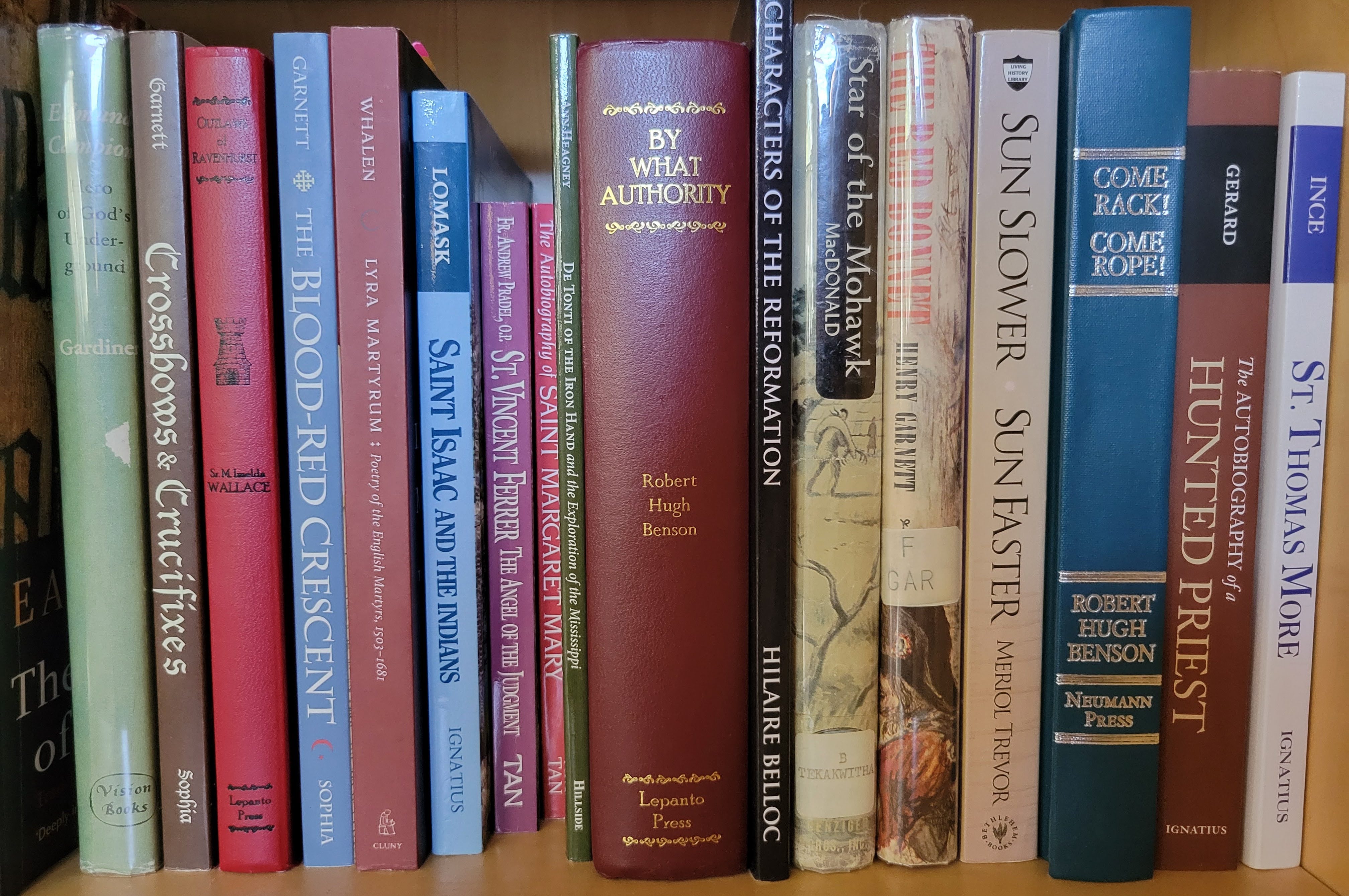
This is a period I enjoy very much, especially in British and European history! There are so many good Catholic books detailing the persecution of Catholics -- and the saints that arose out of that persecution -- in Renaissance England for all ages. It is a part of history that is little included in most textbooks but full of living interest and heroic deeds.

I have all of these currently on my shelf and am in the process of selecting which will be assigned for Sunday reading, which will be simply leisure reading and set on the free read shelf, and which might be family read-alouds.

Biographies

My Form 1 students will read a couple easier biographies from the list below; when they come around to this period again in Form 2 or 3, they will have the chance to read the others. My Form 2 and 3 students have 1-2 biographies assigned each term, depending on age and ability. The rest will go on their free read shelf.

A few notes on the list: The books below have been ordered by series/difficulty level. This list is not meant to be comprehensive; it is just what I have on my shelves or have purchased for this year's studies! Also, Form 3 students who are strong readers may also like some of the options under High School.

Windeatt series: 

Vision series: 

Other biographies:

Historical Fiction

A few Catholic historical fiction options:

Other Notes on Form 1-3 History

Arnold-Forster's A History of England and H.E. Marshall's Our Island Story are both written from a British, Anglican perspective. As such, they laud "Good Queen Bess," pass fairly quickly over the Catholic martyrs, claim that the Church didn't want commoners reading the Bible, approve of the rebellion of the Scottish presbyterians, and so on. I love the books and think they are certainly worth using! I can't really imagine our homeschool without them. However, I do edit a few chapters covering this period and supplement with the above biographies and such about Catholics who lived then and what life was like for them. With this approach, my students get to experience how the viewpoint of the author colors their work.

I have listed below some chapters Catholic families may want to preview. You may decide to include them and discuss them with your kids, or you may choose to omit/abridge.

Our Island Story: Chapter 63 (I begin the chapter at "When King Henry heard..." on p. 285), Chapter 66 (I edit p. 301), Chapter 68 (I omit the first four paragraphs on p. 308), Chapter 76 (I read the first half only, stopping at "Like King James" on p. 346)

A History of England: Chapter 41 (I omit), Chapter 42 (I edit sections on "The Oxford Martyrs" and "The Death of Cranmer"), Chapter 43 (we discuss the section on treason on pp. 365-6)

Also, if students (or parents!) would like a fuller picture of Guy Fawkes, this article is interesting!

For American history using This Country of Ours, you may want to preview Chapters 9-10, which describe when Spanish Catholics brutally attack a group of Lutheran settlers.

~~~

RELIGION FOR FORMS 1-3

Catechetical Instruction

Last year I really enjoyed studying the Mass with my Form 1 and 2 kids. We went through all of the parts of the Traditional Latin Mass using our books and images, did illustrated copywork of some of the most beautiful prayers and responses of the Mass, and practiced using a hand missal. It was very fruitful, especially with one of my little boys receiving First Communion and another beginning to serve Low Mass.

This year, I'm tentatively planning to do a new study each term with resources already on my shelves:

My Form 3 student will read about the same topics but in her own time: O'Sullivan's All About the Angels or St. Michael and the Angels for Term 1, Mother Loyola's Hail, Full of Grace for Term 2, and joining the older kids' study of the Mass in Term 3 with Fr. Knox's The Mass in Slow Motion.

Spiritual Reading and Liturgical Year (read as a family over meals)

We will continue A Character Calendarwhich has been a favorite with my younger students.

We did not finish all of Reverend Halpin's Children's Retreats last year, so we may revisit that for some of our morning reading together. But I am also thinking about re-reading Mother Loyola's First Communion, since it has been a few years! (If you have not read this, schedule it as a family read! She walks through the "types" for the Eucharist in the Old Testament and walks through the life of Our Lord in chronological fashion. This will be our third time through this text and it remains a family favorite.)

(Also, I have some special titles in this post if you're looking for religion books to read aloud to littles or that children learning to read can read for themselves!)

~~~


CATHOLIC SUPPLEMENTS AND RELIGION FOR FORMS 4 & 5 (HIGH SCHOOL)

This year, I will have two high schoolers: a freshman (Form 4) and a sophomore (Form 5). As always, please preview the books listed below before handing to your high schoolers.

History Texts

In addition to the CMEC's high school history texts, I add a weekly Catholic history block to my high schoolers' timetable, during which they will read from two books this year:

Additional supplements for real history buffs:

A few more notes on history:

Ball's Great Astronomers, which my high schoolers will be reading from this year, tells the story of Galileo in the usual way. I would like my kids to read the fuller story so have printed this article on the common misconceptions about the Galileo affair and tucked it into the book.

One benefit of the overall CMEC selections for American history is their breadth. The curriculum includes stories of the French and Spanish settlers of America too, not just the English and Puritans. Even our travelogues highlight some of these lesser-studied figures and events. Much British writing from or about the period is very anti-Spanish by default, so I am happy to have, for example, Cabeza de Vaca's account to balance this out. Just because this was the period of treasure-hunting Spaniards does not mean all Spanish were brutal, obviously! And I'm pleased for my students to read about the Frenchman Marquette, who has a beautiful story of adventure and service to the native peoples. I am sure these will inspire worthwhile discussion in our home this year.

The high school book the CMEC uses for general history, Robinson's Medieval and Modern Times, is much more even-handed on the Renaissance and Reformation. This year's chapters were a pleasure to read. They will provide good context for what my students have read before and it is perfectly timed for their last pass through this historical period.

Catholic Literature

These will go in their leisure reading time. Some selections tied to this year's studies:
  • Monsignor Benson's Come Rack! Come Rope! (I have an old edition so haven't previewed the one linked) and By What Authority? (both historical fiction -- I read these years ago and know my kids will enjoy them too)
  • Lyra Martyrum (beautiful poetry collection from Catholic martyrs of the English Renaissance)
  • We will also be reading Mazoni's The Betrothed this year along with the CMEC!

Biographies, Autobiographies, and Spiritual Classics from the Time Period

Some of these will be for Sunday reading, some for leisure reading, some for seasonal devotional reading.

Also, the biographies recommended for Form 3 above would also make great reading for a high school student.

Catechetical Reading

My Form 4 and 5 students are still preparing for their Confirmation, as there was no local Confirmation here last year. You can see their reading plan for Confirmation here. They will also spread St. Michael and the Angels (a long-time favorite of mine) and The Mass of All Time (recommended by my oldest daughter, who read it on retreat this spring) across the year.

~~~

I hope this helps those studying these time periods with us this fall!

Any wonderful books I should add to the list above? Let me know in the comments!

(Amazon links above are affiliate links. Thanks for your support!)