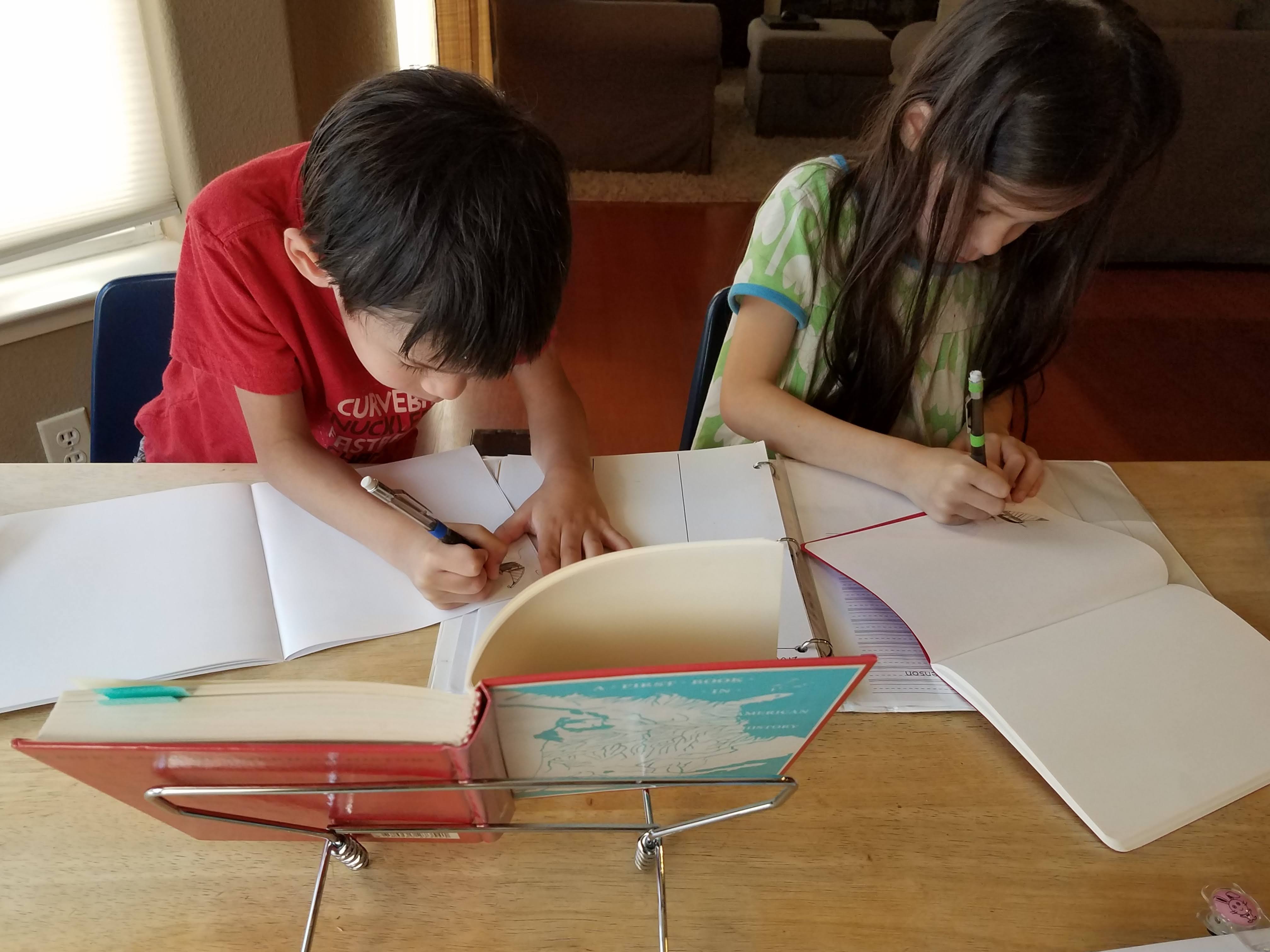
Tis the season for school planning!
Have you been busy pulling together books, resources, and plans for your homeschool? I have been pre-reading quite a lot this summer, and enjoying it all. Usually I leave most of my prep work for my weekly prep session, but with high schoolers this year (and seven students in all!), I felt the need to get a jump start on whatever I could. It has been time well spent.
I have also been preparing a little share here of the Catholic resources we will be using this year alongside our studies for
the CMEC. These suggestions are really suitable for any Catholic families studying the Renaissance/Colonial period with elementary through high school students.
I'm also adding in what we'll be doing for Bible and religion this year. I have a few preparing for sacraments and family and individual spiritual reading to schedule, so I have been happily shopping my shelves.
All the details below!
Bible
The CMEC follows the PNEU in scheduling Paterson-Smyth's books, which are a very good resource for Bible lessons. In fact, on the programmes, Mason did not even list out the Bible text; she relied wholly on Paterson-Smyth's breakdowns and worked from the Scriptures according to his suggestions.
There are a few reasons I really do like Paterson-Smyth. He knows how to get to the heart of a story without neglecting all of the interesting side stories and details. His abridgments of the Scripture texts are thoughtful and helpful. Mason used his guidance to "bring home the story to the children" and think his words do just that. I have learned a lot from his books and will be using them this coming year as helps in planning our own lessons. We will be using his commentaries on Matthew and on Genesis this year, as suggested.
However, there are a few moments in the text where he misses a key Catholic idea (for example, his comments on p. 114 against the primacy of Peter in the Gospel of Matthew). I like to take his suggestions and add in with Catholic resources, so I rely on a couple other books as well:
::
Knecht's A Practical Commentary on Holy Scripture. This tome (it's a thick one!) provides a look at both Old and New Testaments with lots of good Catholic connections, wisdom from the saints, and more. I have used it in various ways over the past few years and always with good results. It is a thorough but usable reference.
::
Mother Loyola's First Communion. If you have not read this, schedule it as a family read! She walks through the "types" for the Eucharist in the Old Testament and walks through the life of Our Lord in chronological fashion. We read her narrative alongside the Gospel of John last year, story by story, and it was truly lovely. This was our second time through the book as a family and the experience was rich.
My plan this year is to read Genesis from Knecht's
Practical Commentary. It helpfully includes the abridged Scripture readings as well as the comments, so it will be a good text for me to work from for my Form 1 and 2 students. For the Gospel, I will use the Knecht commentary and the
Paterson-Smyth book on Matthew to prepare our lessons and then will read from the
Douay-Rheims, which we love.
My high school students will be doing the Bible reading as scheduled by the CMEC: a couple prophetic books from the Old Testament and their commentaries. Saviour of the World alongside the Gospel, and three Epistles spread over the year. Several friends have shared how much they enjoy the Navarre Bible, so I may use
the Major Prophets volume for the older kids. The whole set looks so good!
Just a note about Bible lessons: very often I do not provide any additional commentary for my students. The Holy Ghost often "brings home" the story to the children in amazing ways, and in those moments, I don't feel that I should add anything more. But I do always have a thought or questions ready. The process of preparing Bible lessons has enriched me personally and has encouraged me to read Scripture in a new way.
Catholic Historical Supplements
This coming year, we will be studying 1450-1600 along with the CMEC. This is a period I enjoy very much, both in American and British history! There are so many good additional Catholic books for Renaissance England for all ages, so I am compiling some ideas here in one place for those that are using the CMEC and are Catholic. Non-Catholics who are interested in "both sides of the story" when it comes to the persecution of Catholics in Elizabethan England may appreciate these books as well. It is a part of history that is little included in most textbooks but full of living interest and heroic deeds.
I have all of these currently on my shelf and am in the process of selecting which will be assigned which terms for Sunday reading, which will be simply leisure reading and set on the free read shelf, and which might be family read-alouds. I haven't made any of those decisions yet! I'll be pre-reading this summer to decide.
Note: Several of these suggestions have come from Amber Vanderpol and Amy Snell, who are my go-to sources for good Catholic supplements!
Form 2 and 3
Garnett's Crossbows and Crucifixes (historical fiction about priest hunters and recusants -- my Big Kids loved this one when they were in elementary school)
Garnett's The Blood-Red Crescent (on the Battle of Lepanto, the Crusades, and 16th century Italy)
Vision books on
St. Thomas More of London, St. Edmund Campion: Hero of God's Underground, St. Francis of the Seven Seas (family favorites)
Also a Vision book:
Father Marquette and the Great Rivers (already scheduled by the CMEC as an option for Term 3)
Canton's The Story of St. Elizabeth of Hungary (scheduled by the PNEU even though it takes place slightly before this era)
Sun Slower, Sun Faster (more historical fiction involving priest holes, relics, and time travel -- what a combo!)
First Martyrs of North America (an out-of-print book I picked up a long while back and will have on the leisure shelf for additional biographies)
Form 4 & 5 (High School)
Some of these will be scheduled as biographies, some as historical fiction, some as spiritual reading.
Please preview before handing to your high schoolers.
Monsignor Benson's
Come Rack! Come Rope! (I have an old edition and can't find a good in-print version to link to) and
By What Authority? (both historical fiction -- I read these years ago and know my kids will enjoy them too)
Hunt's Treason (in looking for an edition of
Come Rack! Come Rope! to link, I came across this book, which seems similar)
Waugh's Edmund Campion (thinking of this to replace Twain's
Joan of Arc, which we have already read and LOVED)
Lyra Martyrum (beautiful poetry collection from Catholic martyrs of the English Renaissance)
De Wohl fictional biographies:
The Golden Thread,
Set All Afire (these are fictional saint biographies but often profound and very engaging -- please preview before reading!)
St. Teresa of Avila's The Way of Perfection and
Interior Castle (to offer alongside the poetry of St. John of the Cross, which is already scheduled)
Eamon Duffy's books:
Fires of Faith: Catholic England Under Mary Tudor and
The Stripping of the Altars (I already own these but haven't read them, but I thought some non-fiction would be a nice balance? I need to pre-read them though.)
Belloc's Characters of the Reformation (pre-reading this to choose selections)
My older kids will also be reading from
Starr's Continental Ambitions this year, a comprehensive Catholic history of America. I plan for them to read this alongside the CMEC's American history spine. I am hopeful about this pairing and from the pre-reading I have done so far, think it will serve my high schoolers well through their whole four years. (This was a recommendation from Amber, who also is part of the CMEC high school curriculum team.)
ETA: There are sections of this book that we will be skipping. Be sure to pre-reading this text if you decide to use it!
As I said before: these books will all be added to the program for leisure reading and Sunday reading. The program doesn't need Catholic substitutions. But my eager readers will appreciate the additional selections!
A few more notes on history:
Ball's Great Astronomers, which my high schoolers will be reading from this year, tells the story of Galileo in the usual way. I would like my kids to read the fuller story so have printed
this article on the common misconceptions about the Galileo affair and tucked it into the book.
One thing I like about the CMEC is it tries to tell the story of the French and Spanish settlers of America too, not just the English and Puritans. Even our travelogues highlight some of these lesser-studied figures and events. Much British writing from or about the period is very anti-Spanish by default, so I am happy to have, for example, Cabeza de Vaca's account to balance this out. Just because this was the period of treasure-hunting Spaniards does not mean all Spanish were brutal, obviously! And I'm pleased to be reading about Marquette, who has a beautiful story of adventure and service to the native peoples. I am hoping for a good combination and I am sure these will inspire worthwhile discussion in our home this year.
Arnold-Forster's A History of England and
H.E. Marshall's Our Island Story are both written from a British, Anglican perspective. As such, they laud "Good Queen Bess," pass fairly quickly over the Catholic martyrs, claim that the Church didn't want commoners reading the Bible, approve of the rebellion of the Scottish presbyterians, and so on. I love the books and think they are certainly worth using! I can't really imagine our homeschool without them. However, I do edit a few chapters covering this period and supplement with the above biographies and such about Catholics who lived then and what life was actually like for them. With this approach, I think my kids get to understand how the viewpoint of the author colors their work.
I have listed below the chapters that Catholic families may want to preview. You may decide to include them and discuss them with your kids, or you may choose to omit/abridge.
Our Island Story: chapter 63 (I begin the chapter at "When King Henry heard..." on p. 285), chapter 66 (I edit p. 301), chapter 68 (I omit the first four paragraphs on p. 308), chapter 76 (I read the first half only, stopping at "Like King James" on p. 346)
A History of England: chapter 41 (I omit), chapter 42 (I edit sections on "The Oxford Martyrs" and "The Death of Cranmer"), chapter 43 (we discuss the section on treason on p. 365-6)
Also, if students (or parents!) would like a fuller picture of Guy Fawkes,
this article is interesting!
The high school book the CMEC uses for general history, Robinson's
Medieval and Modern Times, is much more even-handed on the Renaissance and Reformation. This year's chapters were a pleasure to read. They will provide good context for what my students have read before and it is perfectly timed for their last pass through this historical period.
Religion Reading
I always schedule religion reading in a few different categories:
:: saints' lives (assigned by Form, listed above under history because they are also biographies)
:: spiritual reading (assigned by Form)
:: liturgical-year reading (usually as a family)
:: specific sacramental prep (as needed, assigned individually)
I'll start with that last category first...
Sacramental Prep
This year, I have two preparing for Confirmation and one for First Holy Communion...
Confirmation
My Confirmation kids read Knox's
The Mass in Slow Motion (a reader recommended
this version, but I have an older one) and
The Creed in Slow Motion over the past two years, which I have found to be fantastic preparation.
This year, I have some Confirmation-specific reading for them:
For my 14yo son:
Loyola's Soldier of Christ: Talks before Confirmation,
Father Lasance's Young Man's Guide
For my almost-14yo daughter:
Loyola's Home for Good,
Father Lasance's The Catholic Girl's Guide
Really, though, these two kids have read so many wonderful Catholic books over the years that I don't feel like they need much focused preparation for this sacrament! I want to do some special reading to mark the event, but they have read about so many saints, about angels, about doctrine, about the Mass, about the liturgical year, about Our Lady, about the sacraments... Some of these books were written for children, some for adults, and all of them were very good. But we'll see how the year goes and what I end up adding to their stack! Their Confirmation, which was supposed to take place this fall, has been pushed out indefinitely for now due to COVID-related restrictions, so we may have more time for preparation than we expected.
First Holy Communion
For First Holy Communion: I have written up
my general approach to First Communion prep before. My daughter who is currently preparing isn't reading fluently yet, which alters my plans somewhat. She has been reading
Loyola's First Communion with the family for the past year or so and will finish it this coming year. She has narrated her way through two of the gospels. We will focus this year on learning the Ten Commandments to prepare her for her first Confession, and on memorizing the
St. Joseph First Communion Catechism, which includes a short overview of the sacraments and the precepts of the Church and is a requirement of our priest. I think my husband will take the lead on both of those things, as he did for the two last First Communicants we had. It was such a nice time for them to prepare with him! I think I will read
First Communion Days with her, and I will ask one of her older siblings to read from a few other books from that old post over the course of this coming school year. (My kids have all loved
the story of Blessed Imelda and I wouldn't want her to miss it, for example!)
Liturgical Year
I recently bought three sets with simple devotions for the liturgical year and I can't decide which one to use this year! They all look excellent. I think we will jump into
With the Church and then see if we would like to take up the Troadec or D'Hulst books for Advent or Chirstmas or Lent.
With the Church: Advent to Ascension (Volume I) and
Ascension to Advent (Volume II)
Crib to Cross: Meditations on the Life of Christ M D'Hulst
From Advent to Epiphany and
From Epiphany to Lent by Fr. Patrick Troadec
We have been reading from
A Character Calendar most mornings and really like the little stories and meditations.
And as a side note: we recently got
Chadwick's My Book of the Church's Year and my littles adore it!
Spiritual Reading
For my Younger Kids
We pulled together a big Kinderleben Guide for the CMEC this past spring, and one category of books we didn't include is religious reading! But it made me excited to straighten up my kindergarten shelves of religious books.
In addition to religious picture books, lists of which you can find in various places, we have some favorites I save for kinder-aged kids:
Manners in God's House,
I Believe,
Jesus and Mary,
Saints for Boys,
Saints for Girls,
Their Hearts are His Garden, and others.
Also, I highly recommend the
Saints and Friendly Beasts series of easy readers from Neumann Press. Clara (Form 1) is learning to read this year, so I made her a little shelf of easy/early readers and these are some of the best!
For Form 2
My Form 2 kids haven't read
Mother Loyola's Hail, Full of Grace or
Marigold Hunt's A Book of Angels yet, so I think I will schedule those for them this year. (Last year they did
My Path to Heaven and
Montessori's The Mass Explained to Children.)
I also got back out the Catholic Treasure Box series (
Set 1 and
Set 2) for them to read in free time. It had been a while. They have been loving those this summer!
For the Older Kids
My older kids' spiritual reading is covered above under sacramental prep and history since we are using the CMEC's historically-tied religion reading for the Upper Forms. I also take a bit of time at the beginning of Advent and of Lent to choose a few books for their free reading shelf. They like having this to select from for devotional time.
I hope this is helpful to those joining us for the Renissance and Colonial times this fall! I am so happy to see our shelves begin to fill up for next year's studies.
So -- any wonderful books to add to the list above for this period? Let me know in the comments!
(Amazon links above are affiliate links. Thanks for your support!)