Showing posts with label Science. Show all posts

Thursday, August 20, 2015

Kingsley...at the Beach!

Charles Kingsley's Madam How and Lady Why has been a hit so far with my two Year 4 students this term.  It's no surprise, as they were already familiar with and quite fond of his humorous asides and conversational tone.  (We read The Water Babies and Heroes aloud last year; in terms of tone, I think this one falls very close to the former, but the content, being non-fiction, is more straightforward.)

My daughter in particular appreciates Kingsley because he always anticipates her follow-up questions before she even has a chance to comment.  She'll open her mouth to object or ask a question, and the next words I read are, "What! you have a question more to ask?" or "I see you are astonished at the notion."  Gianna just eats all that up.  And how could you not?  His voice shines through with such charm, and we're happy to spend twenty minutes or so with him each week as he shares insight into the hows and whys of the natural world.

But we weren't expecting to find him at the beach last week, though I suppose we should have!  After all, Chapter 1 of Madam How and Lady Why--and the whole book, really--is all about "water, water, you stupid man."  (Yes, according to our house rules, you are only allowed to call someone stupid if you are writing in the nineteenth century.  And yes, that is another reason Kingley's writing invokes lots of giggles.)

Back to the beach:


Vincent spent twenty minutes or so digging a long, narrow tunnel connecting a sand castle he was making to the water (see him there on the left working away?).  He noticed that the deep, narrow tunnel gradually began to grow broader and shallower at the end as the water flowed in and back out.  "It's like The Glen!" he happily reported.

He dug another tunnel to show me.  Sure enough!  It started off with high sides...


And as the water moved in and out, that end of the canyon grew shallower and broader.


And then these crests started to form which reminded us of another bit:
"You know what an odd, and indeed of what a pretty form all these glens are: how the flat moor ends suddenly in a steep founded bank, almost like the crest of a wave--ready like a wave-crest to fall over, and, as you know, falling over sometimes, bit by bit, where the soil is bare." (14)


Of course we were using just sand and not combinations of earth layers, but the concept became clear to the children all the same.

Kingsley encourages us to not to take his word for it but to investigate ourselves:
"But I do not want you to merely depend on what I say.  If you want to understand Madam How, you must ask her questions yourself, and make up your mind yourself like a man ... The Bible says, 'Prove all things: hold fast that which is good.'  So do you prove my guess, and if it proves good, hold it fast." (19-20)
And later in the chapter he makes this point which I think is just lovely:
"For the safest way to learn Madam How's methods is to watch her at work in little corners at commonplace business, which will not astonish or frighten us, nor put huge hasty guesses and dreams into our heads ... So do you be humble and patient, and watch Madam How at work on little things.  For that is the way to see her at work upon all space and time." (23)
We were happy to take his advice without even meaning to, and we are waiting with humility and patience for what Kingsley and Madam How have to teach us through the rest of this year.

~~~

For those of you who are also doing Year 4 science, here are a few helpful parent guides that I look over each week during my weekly planning and pre-reading session:

Story-Book of Science Notes and Activities at the AO Forums
Madam How and Lady Why posts by chapter at Journey and Destination
Carol's Pinterest boards on Earth Science (including MHLW) -- thanks for the tip, Dawn!
Katie Barr's Madam How and Lady Why study guide from the AO website

I hope you are enjoying this year's science selections as much as we are!

Monday, July 8, 2013

Nature Journals - Starting Fresh, Looking Back


We're starting a new school year here today (AO Year 2 - more on that another day!), so I have new nature journals ready for my two oldest.  Before putting away their old ones, I thought I would do a little update on what they have been documenting lately.  

Our nature study group has still been meeting casually through the summer, though it has been a bit sporadic with vacations, illness, and all the usual summer goings-on.  That doesn't mean we haven't been fitting in lots of nature study as a family, though!  Lately, a lot of that time has been spent in our own yard and in local parks, and my kids and I have been faithfully working on our journals and Calendar of Firsts.  Here's a peek at the last few entries in my children's nature journals:

My daughter has really been working on drawing our local birds, trying to get the shape of the body, angle of the head, and coloring just right.


And here is her listing of our current backyard flowers:


Similarly, my son decided one afternoon to catalog all the bugs he found in a day and try to identify them.


An ongoing collection of acorn drawings my daughter added to all fall/winter:


As you can see, a lot of their work lately has been in the form of almanac pages of sorts.  They are entirely their own idea and creation, and I think the impulse is fascinating.  I do it too, but with words, usually making sure I have an exhaustive list of every species I've noticed on a given outing.  But they more often do it with pictures, which is the kind of project that overwhelms me but doesn't intimidate them at all.

And just to show how much progress they have made this past year, I put a few of their entries from the beginning and end of their year-long journals side by side.  And the subject is one of their very favorites--mallard ducks!

By my daughter:

Last year (left) and last month (right)

And by my son:

Last year (left) and last month (right)
Of course, More important than drawing progress is progress in their knowledge and their powers of observation.  But it's fun to see their drawing skills develop as well!

It is such a wonder to me as a parent to watch my children grow and learn with so little hands-on work from me.  I provide the time outdoors, the free time in, the quality books, the sense of order and wonder, the materials--and their minds and bodies do the rest.  And now we're all looking forward to empty notebooks full of possibilities for this new year!

Thursday, May 9, 2013

Trip to the Museum : The Art of Nature

As I said last time, we spent last week at the beach, and I wanted to share a bit about it here because it was a very CM-friendly experience with lots of time outdoors.  Today, though, I want to mention one place in particular, one that I think will be particularly interesting to all the Charlotte Mason homeschoolers out there:


We decided to stop in at the Santa Cruz Museum of Natural History, and boy, am I glad we did!  It's a very small kid-friendly, hands-on museum, with lots for nature-lovers to see and do.  Touch pools with intertidal creatures, stuffed birds, preserved nests, drawers and drawers of seashells, Ohlone artifacts, birdsong stations, a glass-enclosed beehive, and more.


When we first got there, it was packed with two classes of first graders on a field trip.  But after an hour, they left, and we headed back in to have the whole place to ourselves.  (Love homeschooling.)  

But my favorite part was the current exhibition, called The Art of Nature.


The museum walls were lined with journal pages, sketchbooks, and more formal nature prints from local naturalists and scientific illustrators.  (I hope you'll pardon the quality of my photos--most of the examples were behind glass.  My pictures don't do justice to how lovely these were in person!)  As you can imagine, it was wonderful to look through these professional examples, which were mostly done in watercolor, colored pencil, or graphite (media that we too work with in our nature drawing!).  


My personal favorite was the one below, by Jenny Keller, a CSU Monterey professor and scientific illustrator:


You can see her in action here, as well as read her thoughts on the importance of sketching for scientists:
"The fact is, scientific illustrations can achieve certain things that a photograph cannot," writes scientific illustrator Jenny Keller. "A good illustration can portray difficult-to-photograph or rarely witnessed events."
"Sketches created while in the field can also record valuable information -- sometimes even more reliably than photography," Keller writes. "Although cameras are indispensable for capturing fleeting events and complex detail (and I would not go into the field without one), they cannot do everything. Colors in photographs are typically (sometimes dramatically) inaccurate, proportions are often distorted, and key features of the species may not be recorded clearly (or captured at all)."
Interesting thoughts about the place of nature drawing in an education, even in a high-tech world--particularly drawing in the field.  This isn't something I do often because it's just not practical for me in this season of my life, but it's definitely the ideal.

In honor of the exhibit, they had a table set out for children to try their own nature illustrations.  This might have been something new for other kids, but I'm happy to say my CM-educated children felt quite at home!  LOL


And I have to say that I felt quite at home too--just look at that lovely TRAY!  I think the museum curators must be reading our blog! ;)

As you can imagine, it has sparked lots of nature journaling here at our house.  Don't you find it inspiring to look at the work of artists?  And the museum works with local universities to offer nature illustration courses--if only we were more local.  For now, I'll be content working at the kitchen table with my kids...and really there's no place I'd rather be!


Tuesday, November 20, 2012

Squirrel Signs


The outdoor hour challenge for this month came at a perfect time: our squirrels just returned to the yard about six weeks ago.  We see them year-round, but lately they're back to hanging around all through the day--or at least whenever my littles are indoors and the yard is "safe" again. ;)  To be honest, although they're rather cute and fun to watch, I am not a squirrel fan; I consider them pests because of the destruction they tend to create on the yard and house, and I'm not too thrilled when I see them around.  But the children love observing them.  We have a row of huge black walnut trees across the street, and we sometimes see them jump from tree to tree from the front window.  Out back, they adore our plum tree, and we often see them digging up the grass to bury acorns they have brought from neighbors' yards.  

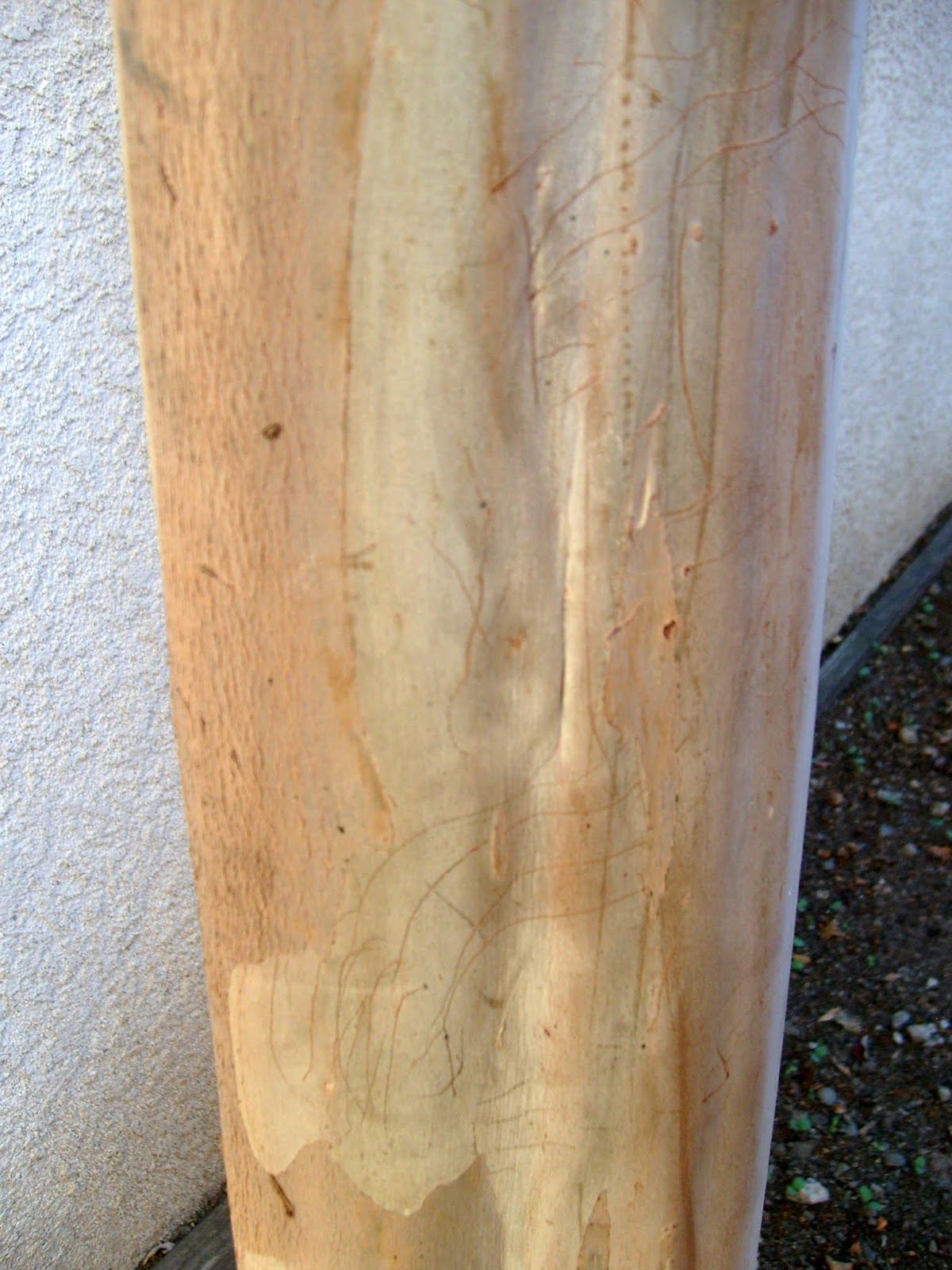
The other day, we were in the side yard, where we have a row of crepe myrtles, and the kids were admiring their peeling bark.  A close-up look led to a little discovery.


"What are these marks on the trunk?" they asked.  Neat little parallel scratch lines, in various directions, going up the trunk.
"Well, what do they look like they're from?"
"Nails.  Maybe squirrel nails?!"


They continued their investigation.  "So why are there scratches on these trees and not elsewhere?"  I heard them narrow it down to three possibilities:
:: Perhaps they only climb on this tree.  (They immediately dismissed this one since we see them on the other trees all the time.)
:: Perhaps since this trunk is smooth, they need to dig their claws in more to work their way up.  (Perhaps.)
:: Perhaps since this trunk is smooth, it shows the claw marks more obviously than the other trunks.  (They went to check the other trees but could not see any other scratches at all, no matter how closely they looked.)

So now they're itching to check the sycamores at the park around the corner, which are favorites of the squirrels there and which, obviously, have similarly peeling bark.  They also want to see whether some semi-smooth trees have obvious scratch marks, since the plum we compared it to has a particularly gnarled, rough trunk.  And a bit of wonder leads to a bit of scientific investigation...I'm interested to see what they find out!