Showing posts with label The Living Page. Show all posts

Saturday, April 12, 2014

The Living Page :: How to Be an "Awakener"

(Today I'm joining the chat about Chapter 4 of Laurie Bestvater's The Living Page.  You can read my thoughts on the first three chapters of this book here.)


At the end of my last post on The Living Page, I said that Bestvater moves from the philosophical to the practical in this next chapter.  And certainly it's true that she provides in this section some helpful suggestions that are both doable and in keeping with the principles she has outlined up to this point in the book.

But what I most appreciated here were the descriptions she has sprinkled throughout about the responsibilities we have as homeschooling mothers.

There's a lot of talk in Charlotte Mason circles about "masterly inactivity."  But I almost always see the term mis-applied to the student and basically defined as the free time a student has to pursue his own interests.  That's not quite what Miss Mason meant.  Pulling from her own words on the topic: 

'Masterly Inactivity.'––A blessed thing in our mental constitution is, that once we receive an idea, it will work itself out, in thought and act, without much after-effort on our part; and, if we admit the idea of 'masterly inactivity' as a factor in education, we shall find ourselves framing our dealings with children from this standpoint, without much conscious effort. But we must get clearly into our heads what we mean by masterly inactivity. ...  Perhaps the idea is nearly that conveyed in Wordsworth's even more happy phrase, 'wise passiveness'. It indicates the power to act, the desire to act, and the insight and self-restraint which forbid action.  (Volume 3, p. 28)

So masterly inactivity is something the teacher does, not the student.  It's a small but important distinction.  The teacher restrains herself and stands aside, letting the child make his own connections, form his own ideas, and progress toward self-education.  Outside of lessons, that means the teacher leaves the child to his own interests and play for part of the day; during lessons, the teacher makes a point of stepping back at times to let the child take possession of the ideas presented for himself.

But we're not just talking about inactivity here.  It's masterly inactivity.  So what about that masterly part?  

Most of us are familiar with the ways in which a teacher in the Charlotte-Mason style is not playing a typically-"masterly" role.  She is not involved in the digestion of ideas; she doesn't do the child's mind-work for him.  She doesn't force connections--she lets the student build his own.  She doesn't coax, cajole, bribe, or use other methods of persuasion or suggestion.  She makes sure to let the child alone when necessary.  She doesn't try to determine and guide every part of the student's learning experience in order to get a particular result.  And so on.

But Miss Mason considers all this to be "masterly" in the sense that the teacher must practice self-control to keep herself from intervening.  But at the same time, she plays an absolutely critical role in the formation of her students in many, many other ways.  In truth, there's quite a lot that the teacher is "master" of in a Charlotte Mason-style of learning beyond her own desire to act.  Her role is much more subtle than we have come to expect from traditional education, but it's not any less crucial nor any less encompassing.

Throughout this section, Bestvater gives us glimpses at this nuanced, varied, mostly invisible (yet undeniably important!) role of the teacher in Charlotte Mason's educational approach.  I want to pull all those glimpses together, organize them, and consider how we might put them into practice in our homes--and not just with our students.

~~~

So what responsibilities does a teacher have in a Charlotte Mason education?

:: Understanding the principles that inform our practice.

This has been the thrust of Bestvater's book all along, so it's no surprise that she includes this as one of our first responsibilities.  Anyone can adopt Miss Mason's methods, and sometimes to good effect.  But without at least a basic understanding of the whys behind this approach, the methods fall flat.  They may have piecemeal success but they likely will not form the kind of learners over time and across subjects in the way we are hoping.  

As Miss Mason describes it, we need to approach this kind of education not as a system, but as a method--and the key to a method is the principles that govern it.  Bestvater here suggests that if one doesn't understand the principles, one should perhaps slow down on the how and take that time needed to understand the why:  "If our besetting question is, 'how do I do this? we may need to pause a while ... We may need to review Mason's unhurried rhythms to adjust our pace before considering the practical out-workings I have attempted to gather from her writings and lay out in this chapter." (70)

So first things first: make ourselves "familiar with the parameters and genius of each venue" before we try to adjust those "venues" for our own needs (70) .  I can't imagine that we must understand the principles completely before we even begin; we are constantly learning, after all, and experience helps along that learning experience.  But at the same time, we don't want to get so caught up in putting all the ideas into practice that we forget what the ideas were in the first place.

:: Adjusting our expectations to match our principles.

Part of understanding Miss Mason's principles is making sure we're not falling into the expectations of traditional schooling.  Bestvater directs these comments at schoolteachers, suggesting how they might handle parents at their schools who might not be used to the way a Mason education works.  But I think this is also relevant to us homeschoolers, even those of us who are Charlotte Mason devotees.  Although we might understand and embrace the principles of a Charlotte Mason education, we might not have fully reformed the expectations that we (consciously or unconsciously) bring with us to this homeschooling journey.  Sometimes those expectations are just natural inclinations; sometimes they stem from our personality or parenting style; sometimes they're left over from the traditional schooling we went through as children.

These expectations might show up in many different ways.  For instance:

We might get so caught up in the idea of "perfect execution" that we forget that we should "hold that expectation with good humor, in tension with the fact that the children's abilities will continue to improve" (70).

We might have our eyes on the beautiful Keeping we hope our child will embrace, forgetting that our "child's notebooks are not primarily products or even mainly for the display of the student's learning" (70) and as such, may not meet our vision of what a notebook "should" look like.

We might forget that the most important response a student can have to a text is to "allow personality to work on what has been taken in" (72) and that the product such a convergence produces might not be  "particularly attractive in itself" but is nevertheless "indicative of a great mental effort" (71).

We might be in a hurry to see our work bear fruit, and "in our eagerness for the beauty we see revealed in Mason's view of education, we can forget that many of these layers are built up over years, not weeks or months" (80).

We might not be tempted to intervene when we don't see the tangible results we're looking for, when instead we should consider Bestvater's advice: "We look for ways to scaffold and are patient.  We let the children do their rightful and meaningful work" (70).

We need to trust that the "work" is happening even when the results aren't quite what we expected.  We need to back away from needing proof of learning, whether for our own satisfaction, or to show family and friends, or to meet state requirements, or to excel at testing.  Part of being a Charlotte Mason parent-teacher is coming to terms with a method of schooling that produces different kinds of results than what we're used to or what our friends' kids might be bringing home.  That may mean that we need to reconsider our own habits and desires to see if they are in line that the principles we claim to practice.

:: Using discretion and creativity to curate the feast.

The teacher who understands Miss Mason's educational principles and has the proper expectations of her students is then free to adapt the particularities of the feast to suit both her own tastes and the needs of her students.  Indeed, she is encouraged to make what decisions she deems suitable--and there will be a lot of them.  I definitely don't mean you need to create an individually-tailored booklist for each child or DIY your own Charlotte Mason curriculum (though you could if you wanted to).  But even if you use a booklist nearly or completely as-written (as I do with Ambleside Online), there are still plenty of decisions that the teacher must make, relying on her own "discretion and creativity."  As Bestvater puts it: 
We follow the spirit of the law and not the letter; maps, narrations, math tests--there is no perfect way to order it all, no Mason 'system.'  We are after the 'suitable, 'tasteful' solution to 'good effect' all the while keeping the particular notebook and principles of her pedagogy in mind ... We can be flexible and creative.  Once the principles and options are understood, variations and adaptations are not only possible but desirable in the face of individual needs. (82-3)
We should consider thoughtfully how we design and approach the teaching of each subject.  In the case of narrations, that means "looking over the day's work to see where certain kinds of narrations suggest themselves ... balancing the written, drawn, sung, painted, acted, etc" (70).  And in the case of Keeping, Bestvater tells us: "By now it will be apparent that there are few hard and fast rules about using most of Miss Mason's notebooks.  We survey the possibilities, watch for the student's spark of connection, and use our discretion and creativity to suggest a 'form'" (80).  She adds later, "when to add a notebook and how to organize student work must still be organic to the school, teacher, and student.  Personality is involved." (82).

It goes back to the forms of vitality discussion from last week but on a different level.  Just as the notebook gives form to the student's ideas and education (the vitality), Miss Mason's methods and principles give form to the personality, creativity, and discernment of the teacher (the vitality).

:: Providing support for self-activity.

The more hands-on part of our teaching role is supporting our students.  Our goal in the end is self-education; our goal along the way is self-education too.  But ironically, self-education doesn't necessarily happen without preparation and scaffolding from the teacher, at least at the beginning.  That includes cultivating the proper atmosphere, building good habits, providing physical and emotional support, and so much more.  As always, though, the level of our "support" is in keeping with Miss Mason's principles.  It not only respects the child by refusing to overstep boundaries but also respects the child by giving him the support he needs to succeed.

I'll use the Nature Notebook as an example of how we might hit that properly-balanced level of support, quoting copiously from Bestvater's suggestions:

When the habit of nature journaling is first introduced, "the teacher can give a little of the rationale for the book or introduce its use in an interesting way ... [and] let the children in first form know they are embarking on a school-wide, cherished tradition in keeping a Calendar of Firsts or that their Nature Notebook will be with them, hopefully all their lives" (77).  The teacher takes care in "choosing paper that answers both for writing and brush drawing" and "each student should ideally have his own notebooks and supplies" (73).  And more: "The wise teacher will give various supports so that a child is not frustrated by an expectation beyond his ability; he is assigned only that which he is fully able to do" (76).  The teacher provides the materials, lines out the expectations, and builds interest.

Early lessons in nature Keeping should involve how to use the paints properly, not because a perfect product is expected but because our goal is to set the student up for success: 
"Watching a seventh grader who had obviously never held a paintbrush struggle with a dry brush painting in his new nature notebook showed his teacher that all that paint mixing and big brush work at the easel in the early years has its place, is actually a way of showing respect to a child, as it would eventually enable him to be at home with his old friend the paintbrush." (77) 
So at the beginning, "instruction about dry brush technique, positioning the specimen on the page, observing quietly and carefully before starting will be part of all early lessons with a goal of independence."  And  "the teacher will help the students create life lists and calendars of sightings in the back of the book, students and teachers agreeing on a format that is simple and useful" (80).  At this stage, the methods and habits are taught, but still, the content is always the student's.

As the student grows in his notebooking, "the teacher respects her students by recalling how to proceed before the notebooks are opened" each day.  She also makes sure to give "enough time for an activity; frustration ensues when beginning a dry brush drawing that one cannot finish because the bus is here" (77).  And farther down the road, "The teacher will also work to transition the child from being asked if there is anything he wants to include in his Commonplace to handing over responsibility for its use to the student" (79).

In short, it is the teacher's role to "intuit the right level of support and encouragement for each child's best discovery and growth" (69) and to create "a place that preserves a pace and structure for mindfulness and human flourishing" (75).  We want to build friendships between our students and their work.  Part of helping someone build a friendship is making proper introductions, and part is nourishing the habits that will make that friendship grow.  It's a critical role indeed--and even more than that, a sensitive one: "In these simple and unassuming ways, the teacher can introduce and create the means for the budding friendship or conversely create a distaste or aversion with rigid remarks or disapproval" (77).

:: Being a co-learner.

In addition to helping the student form friendships, we as teachers should be cultivating friendships ourselves.  This is another way in which Charlotte Mason's methods diverge from traditional thought.  We as parent-teachers are responsible for our own paper postures, "mother culture," and so on.  In the case of Keeping, this means making at least the three main notebooks part of our routine:  "The teacher in a Mason learning community is a co-learner, and it is very helpful for a teacher to model to his students (and parents) that his own learning also includes some comfortable notebook friends" (72).  

But the goal isn't just to model good educational practices for our students--at the same time, we're also being formed by those practices ourselves.  And actually, the two goals build on each other: "materials have the most influence on learning when they are used together with another human.  More than just together with, children learn best when an adult interacts in the process of using materials and when learning takes place as a social or collaborative process" (72, Lewin-Benham quoted in Bestvater).

Through setting ourselves up as co-learners, we are showing our students how learning happens and we are learning as we do it--the best of both worlds!

:: Assessing and responding.  

As a child moves toward self-activity, we teachers have a new role to play.  Our "creativity and discretion" aren't limited to curating the feast; we should also be constantly re-considering the needs of our students, marking their struggles and successes, assessing where we might support them better and where we might move them further toward independence, and responding to their work and ideas.  

I have always thought of end-of-term exams as my main mode of assessment, but Bestvater is talking about more immediate feedback--you see an issue one day, you're able to address it the very next.  In this way, Keeping provides a special opportunity:
In observing the child's connections to the material unfold with the notebook, the teacher quickly knows how to adjust the next day's lesson, provide a visual aid, have a weaker child narrate a shorter passage, or go more deeply into an unexpected area of interest.  This is feedback at its most immediate and effective, largely eliminating the need for disembodied and tiresome tests and quizzes. (84)  
They provide an chance to check in with a student, see where he's struggling, see where "targeted interventions" might help.  In this way, a notebook is a powerful tool indeed.

And beyond responding by providing support and scaffolding for areas of difficulty, we can also literally respond, interacting with our students in a mind-to-mind way.  As Bestvater says, "We don't want students to depend on our approval but we do want to share the experience with them" (84).  We're not talking about marking with grades or corrections; rather, we might note alongside their writing our own "genuine thoughts on the Great Conversation represented in the student's book," "the occasional respectful comment," and thoughtful questions that will encourage each child "individually to stretch just a little above his level" (84-85).

~~~

So looking back over those categories, one might say that:

Before we begin educating,
we work to understand Miss Mason's principles,
we adjust our expectations to match those principles,
and we then use discretion and creativity to curate a feast for our student.

And as we educate,
we provide support for our student's self-activity,
we act as a co-learner,
and we assess and respond to their learning.

But of course, one of the lovely things about a Charlotte Mason method of education is that it's organic.  These steps don't happen in a vacuum.  Personality is at play.  Connections and ideas form and reform.  Real mind-work is happening, all the time.  We don't put the student into our educational machine (even one with a CM-friendly booklist!) and expect a particular result to pop out at the end.  Yes, we need to learn the "fine art of standing aside."  But our role is not a hands-off one, even during those times that we are "inactive," and we're responsible for actively teaching as well.  So we continue to learn more about Miss Mason's principles while we provide support to our students.  We adjust our expectations as we assess our students' work and learn alongside them.  These steps all build on each other, and as we move along this homeschooling journey, we become better, wiser, more thoughtful teachers.

~~~

And to go on a bit of a side note before I close, I'm struck by how so many of these habits would serve us in other areas of our lives.  I'm not suggesting, of course, that we treat our husbands, families, or friends as our students/children. ;)  

But, for example, what if we more often:
:: discerned whether "standing aside" might be the best approach with a tricky family situation rather than immediately jumping in to intervene?
:: used our creativity to troubleshoot a problem in our home routine?
:: were patient with ourselves in what we're able to accomplish, trusting that our own progress will occur at the right time and rate?
:: encouraged our husband in his individual progress without comparing him to others?
:: realized that the process of learning and growing can look quite messy from the outside?
:: assessed regularly our relationship with each of our children, introducing targeted interventions as necessary?
:: approached our husband as a co-learner, even in areas about which we might know more?
:: scaffolded our children's chore training, providing the training and materials needed to set them up for success?
:: asked thoughtful questions and responded with genuine interest when someone shares their thoughts with us?
:: allowed respect for the personhood of each member of our family to govern our interactions?

What our role comes down to as a Charlotte Mason teacher is mindful, careful, thoughtful interaction with our students--and our role as a wife, mother, and friend is much the same.  So I think there is definitely something to be gained from approaching all our relationships in this spirit.  

Knowing when to let alone, when to adapt, when to intervene...to be honest, I often don't have the wisdom to make those kinds of decisions.  But the Holy Ghost does, and he has put me in this place at this time in relationship with these people.  With His guidance, along with experience, continued learning, and my own faithfulness, I can be the kind of "awakener" that I long to be for my children.

Friday, March 21, 2014

The Living Page :: "A Learner Awake" in a "Fill-in-the-Blank World"

(Today I'm joining the chat about Chapter 3 of Laurie Bestvater's The Living Page.  You can read my thoughts on the first two chapters of this book here.)

In Chapter 2, Bestvater detailed all the various notebooks used in Miss Mason's schools.  There are certainly a lot of them, but no matter what the format, what the subject, what age they're meant for, what media are used--they are all, at their heart, composed of blank pages.


This is a break from traditional education today, and it's a break from the kinds of notebooking done in many "Charlotte Mason" circles.  When a student sits down to work on the kind of notebook conceived of by Miss Mason, there are no fill in the blanks, no multiple choice, no words or pictures to match.  There might very well be boxes or gridlines or ruling or columns, and there are usually clear guidelines and specific advice or assignments given by the instructor/parent.  This is not unschooling, after all.  But whether a Nature Journal, a Commonplace, a Book of Mottoes, a Century Chart, or any other of the many formats of notebooks used in her schools,  the student starts with a blank page.  This is an absolutely essential feature of Keeping in a Charlotte Mason education.

The question she's really getting at here in Chapter 3 is why?  Why does Miss Mason prescribe so many notebooks, and of so many different kinds?  Why does it matter if we include them or not, particularly when we can't be certain quite how or when from her writings?  And why in this format -- why the blank page?

That last question is her main concern, and she answers it primarily from a philosophical standpoint, explaining how this practice points to, as always, the educational principles on which it was based.  Working from Bestvater's answers and doing a bit of thinking of my own...

Why?  Because starting from the blank page...

:: Gives form to our vitality.
It might sound strange--how does the blank page give form?  By "form," Miss Mason isn't talking about a particular product.  She's talking more about an opportunity.  As Bestvater says elsewhere, form means "the time and space" for thought, for growth.  The notebook provides the opportunity to consider, to record, to think through the ideas the student grapples with in his education.  And it's precisely the openness and flexibility of a blank page that provides that form without limiting the vitality, squashing creativity, and turning ideas into products.  The blank page encourages mind-work without doing the mind-work.

:: Supports personalized learning.
On a related note, each student's product is not going to look the same, and that's the whole point: "the notebooks Mason favors are all highly personal, as all leaning is highly personal.  They are a unique framework for the child's own learning.  Some are more formalized that others, but none are arbitrary or 'busy work' ... The practice of using these books is begun and buttressed by the atmosphere, discipline, and life of the school and teacher, but their content is clearly driven by the child and comprises a highly personalized journey and retelling" (63).  We provide the form; the ideas and the student's acting on those ideas is the vitality; and something new and personal is created through the process:  "With the use of her notebooks, we come to see that Mason's equation is always: the written word or true-life thing + imagination = personal re-creation" (64).

:: Doesn't just exhibit formation but is a formative act.
These notebooks are "instruments as opposed to artifacts"; they are not just "containers for the child's narrations" (64).  They're not there to show what we have learned.  They're there to facilitate that learning.  As such, they are better thought of as postures or activities rather than products.  And though we expect a student's best effort and provide the supplies, time, and development of skills for that effort to bear fruit physically, the end goal is not a beautiful result.  The goal is a formative process.

:: Demonstrates our respect for the child.
This is absolutely key and, I think, why these kinds of notebooks are not often used in traditional schools.  By providing the blank page to the child and allowing him to do his own work, we "learn the humility and art of respecting the child, of paying attention to each individual's learning process" (64).  We have to be ready to trust that learning will happen, that the books and the process (and yes, the Keeping) will form the student without our hovering or providing answers.  We have to allow the student to do the mind-work.  We have to allow self-education to occur.  And Miss Mason assures us that self-education will occur if we only provide the generous feast, the habits, the "time and space"...and the forms.  As Bestvater says, "If a person can only be built up from within, what else but the freedom of the blank page transmits that confidence?" (67).

:: Is a sacramental approach.
With Bestvater's insistence on the physical from the start of this book, I have been mulling over this idea of sacramentality, a term she has used several times so far, here calling Keeping a "sacramental approach to life" (66).  As a Catholic, I see sacrament as a spiritually-charged word, but I appreciate its metaphorical value.  As a sacramental action, Keeping places an emphasis on the physical as the conduit for the mental and spiritual.  It involves routine, postures, reflection.  And perhaps most importantly, just as does a sacrament, it is what it signifies.  In other words, notebooks don't just signify learning--they are learning.

:: Is a means of entering the Grand Conversation.
As Bestvater says in this chapter, Keeping "speaks an unconscious but powerful message about the Great Conversation: 'it is worth having, and I too have a voice'" (76).  The digestion involved as a student culls, copies, selects, draws, notices, Keeps--this is the beginning of seeing his place within the scheme of the liberal arts and making his own contribution to it.  (And I would add add that perhaps that message isn't always unconscious, and perhaps it needn't be.)

:: Encourages not just cognition but metacognition.  
It's not just about noticing--it's about noticing that we're noticing: "Ultimately, the blank page makes us examine our thoughts for metacognition, and intrinsically, it insists upon space and time for learning" (65).  A student doesn't just see a wildflower, for example; he sees it, and he records that he saw it in his Nature Notebook, and as he does so, he becomes aware of what he knows and thinks and makes further connections...and the education unfolds.  I experience this when I'm blogging too: I can read and understand a chapter (cognition), but Keeping, like narrating, makes me aware of what I understood (metacognition).

:: Is a conduit to friendship.  
And by friendship, I mean that close familiarity one has with "books and things," as she calls it.  You make the time to sit down and think, notice, write, draw, chart, narrate.  And through that time, working over the once-blank page, relationships with ideas develop and link to other ideas--the "science of relations" in action.

Bestvater lays out the beauty of the blank page so keenly in this section that I found myself even more in love with this method of educating than I was before and even more convinced of the place Keeping has within it.  (And that's saying a lot!)  She asks at the end, "Is it too much to say a child's growth and transformation demand these open-ended postures?" (67).  No, I don't think it is.  I think if we're looking for the kind of "growth and transformation" that Miss Mason promises, if we want to raise a "learner awake" in a "fill-in-the-blank world," then blank pages are the perfect companion.  

So what do you say--are you convinced?  Does the blank page feel like a paradigm shift to you?  Does it seem as natural a fit as it does to me?  Have you been faithful to the blank page in your own education or the education of your now-older students and want to share about the fruit borne of that practice?  My children are still young.  I haven't seen how these methods work over the course of a student's growth from child to adult.  But what I have seen in just our few short years of homeschooling has already instilled in me a trust in their self-education, and I can't wait for what is to come as they continue to learn alongside their "paper companions."

In the next chapter, we're moving back from philosophy to the nuts-and-bolts.  Looking forward to reading along with you!

Thursday, March 13, 2014

The Living Page :: Time Tools


(I'm sharing my thoughts here as I read Laurie Bestvater's The Living Page.  So far, I've discussed the place of Keeping in Charlotte Mason's vision for education, nature journals, and copybooks.  Today I'm hitting the last section of Chapter 2, which focuses on history notebooks.)  

I admit: I nodded wholeheartedly when at the beginning of this chapter, Bestvater asks whether my own history education was scattered, un-living, and (as a result) nearly completely forgotten.  Yes, yes, and yes.  I know this is a lament for many who were taught in traditional ways in traditional schools.  Most homeschooling mothers I know seem to think that more hands-on projects or crafty supplements are the answer, but Miss Mason recommends something different, which should come as no surprise for those familiar with her work.  Of course, living books and narration are the hallmarks of her approach to history.  But (just as we see in every other discipline) alongside those methods are various kinds of notebooks that prepare the mind, scaffold learning, and work as another form of narration.  These records--or "time tools," as Bestvater calls them--are a key to the student's successful historical understanding, and the ways they were conceived of and used in her schools was precise and, as with everything else in a Charlotte Mason education, carefully considered.

Jen summed up this chapter so nicely, explaining the key forms, when they were used, and what they were meant to look like.  I'm going to focus just a few thoughts here on the types of historical Keeping meant to be used with young students--or in other words, the types I'm planning to put into practice right away with my own young ones!

The notebooks suitable to the earliest years (Form I and early in Form II) are unique in that, unlike the Book of Centuries, they are meant to be kept for only a short time.  The Book of Centuries is meant to be a lifelong activity, beginning about halfway through the child's school education and continuing throughout life. These early formats were planned to prepare younger students for that kind of culling and mapping of time to come.

The Child's Own History

This is not something I have read about in the past, so I'm looking forward to trying it with my two Form I students soon.  The idea is to chart with the child the years of his life, starting from the present and working backward as far as the child can remember and to his birth.  Included for each year would be the child's age, the ages of his siblings, and other important events he might remember, starting from personal events, then including public events, and then national events--a special trip, the observation of a holiday, a memorable news event, and so on.  These can be written onto the chart or symbolically represented.  The goal is to work with the child to create a visual representation of his own history, which serves to prepare him to understand his own century, and then the vast stretch of history.

And since I'm always concerned with the format Keeping takes, I'll add that Bestvater is very clear on that point: "Something framed in the way of a sampler is suggested ... there are probably many ways to create such a cherished record for the child that awakens interest and is highly personalized just so long as it is not enclosed in a book.  The chart needs to be highly visible, a type of wall art" (46).  So this is intended to be a visual record, something worthy of display.  My children aren't up for a sampler (ha!), but I'm sure they would love to create this in a more artistic way than just a paper chart.  Any ideas?  Bestvater suggests the final project be something special, a keepsake.  I'm not a particularly crafty mommy, but I think working in a different medium might make this a fun summer project.  Maybe they could paint on a small canvas?  Collage onto a wooden box?  Something out of clay or wood?  Fabric arts?  Pastels or watercolors?  If you have any ideas (or if you have done this project already in your own home), please do share.

Table of History
In order to give definiteness to what may soon become a pretty wide knowledge of history--mount a sheet of cartridge paper and divide it into twenty columns, letting the first century of the Christian era come in the middle, and let each remaining column represent a century BC or AD as the case may be.  Then let the child himself write or print, as he is able, the names of the people he comes upon in due order, in their proper century.  We need not trouble ourselves at present with more exact dates, but this simple table of the centuries will suggest a graphic panorama to the child's mind, and he will see events in their time order. (quoted in Bestvater, 39-40)
According to Bestvater, this quite Table of History was probably introduced toward the end of Form I.  We actually began something quite similar when my children started Year 1, and I have found it invaluable in encouraging my children to make connections across their studies.  Ours doesn't quite fit Bestvater's reading of what was being used in Miss Mason's schools, but I'll share it here and then point out the differences between what she describes and ours:

My children each have a personal binder timeline that they add to weekly--they choose what to include and how often, but it's usually one or two entries a week.  Most of the entries are just the names of historical figures, but there are events in there occasionally as well (they both just added "The War of the Roses" last week, for example).  They choose what to include.  It is set up in columns just as described here, and the children just make simple lists in the appropriate century's column without considering the exact date.  Ours is not visual in the sense of being hung on the wall--and that's a big difference, since Bestvater sees this as an essential feature of this table.  I find that the binder timeline is still reminiscent of a "graphic panorama" in that it has a simple graphic layout and is accessible to the children whenever they like, so it suits our purposes for now.  The other reason I went with a binder version is the size, which is another difference between ours and the one described here.  Our columns are a couple inches wide, making the whole timeline much longer than the recommended one-page spread.  I can't quite wrap my head around how lists of names could be written by children in the narrow columns prescribed here, so the larger format is suited to our needs.  (Bestvater has the names written vertically in her model--was this perhaps what was intended?  It doesn't seem all that useful to me, but perhaps I'm missing something.)  I have been pleased with this format so far in that it does encourage the children to start to "see events in their time order" and to understand the relative passage of time through the simplicity of the design, and they have taken ownership of it.  They refer to it several times a week, just flipping through and making connections: So Haydn, Mozart, and Beethoven all lived at the same time! and Laura Ingalls Wilder was writing in America when Rudyard Kipling was writing in England!  and so forth.  And when in a couple years they are ready to begin their Book of Centuries, they will have already begun to grasp the abstraction of time through these concrete methods.

~~~

Speaking of the Book of Centuries, I'll admit: this section made me really happy that my children aren't yet at the age to have started one quite yet.  As Bestvater herself describes in this chapter, a much fuller understanding of the precise form and methods of these time tools has developed over the last few years thanks to the accessibility of PNEU documents, and I feel fortunate to be able to put this fuller understanding to use in my home teaching.  And I also have to say--I so appreciate Bestvater's insistence on going to the source and on presenting as precisely as possible how these tools were conceived of by Miss Mason and used in her schools.  There will be times I need to adapt her suggestions to suit my own family, but I just love an author that makes the purist case and allows me to consider the practical side of things for myself.
Some have argued that there is no use in being a Mason purist, and I take the point.  Likely any timeline is better than no timeline, but if Mason and the PNEU gave careful thought to scaffolding the child's growing time sense, are not some important principles at stake if we depart for the sake of convenience or personal preference for a less considered activity?  For example, if the figures and dates are pre-printed or already selected for the child's insertion on a ready-made timeline, hasn't some mind other than the child's really done the connecting, selecting, and most of the sorting?  It seems likely that there will be less attention and interest paid to this sort of timeline than to the personalized one Mason has envisioned, and hence less connection and retention.  With a pre-printed or parent-chosen model, at best the child uses his scissor skills and finds the appropriate century to insert the cutout.  Likewise, a classroom-sized timeline tracing the circumference of the room, while it upholds the mandate to keep the timeline a visible reference point, loses its condensed map-like impact.  If a timeline only covers the history being studied in that year in that particular classroom (taking part of the role of the history chart), it is a helpful tool but still manages to be less effective than what it seems the PNEU proposes.  I am not suggesting we follow this rather involved trail just because it is the path Charlotte Mason trod; I hope I am presenting enough evidence to instigate a closer look at all her various practices in a search for the very good reasons underpinning them. (49-50)
I am grateful to her for presenting this evidence and taking this closer look, and I'll certainly be considering our current and future practices in light of it all.  It's an exciting time to be starting out as a Charlotte Mason homeschooler.

Monday, February 24, 2014

The Living Page :: Copybooks

The second chapter of Laurie Bestvater's The Living Page can be broken roughly into three parts: nature journals, copybooks, and history notebooks.  Last week, we talked about nature journals, and today, I'm focusing on that second category: copybooks.


Copybooks for my children:
Most of the suggestions she makes here are for older children--notebooks for keeping snatches of music, lab research, Scripture passages.  I was wowed by the Music Notebook, inspired by the Fortitude Journal, and happy to see a Foreign Language Notebook, which I already keep for us (on Evernote).  But I was most interested in the books geared toward younger learners, and I'm going to highlight those here.

A copybook is essentially a housing place for copywork.  But in calling it copywork, I do not mean for it to seem mundane.  In fact, Miss Mason envisions it as quite an inspiring activity.  As Bestvater explains, the key factor in a copybook is that the Keeper has a connection to the passages selected: "Students would still be instructed by the slow copying of beautiful lines but, characteristic of Mason, the words would be the ones that spoke to their hearts, or at least be words with a context--coming from their readings." (28)

So the child progresses in penmanship from practicing strokes on a chalkboard; then to perhaps individual letters on lined paper; then to working through a sentence slowly, word by word.  And at that point, copybooks can be introduced.  Ms. Bestvater mentions several that might be suitable for this age, for example:

:: A Poetry Book, where the child keeps favorite lines or stanzas: "But a book of their own made up of their own chosen verses, should give them pleasure" (quoting Mason, 29).
:: A Motto Book of favorite literary selections, organized by theme, perhaps choosing one motto for each day of the year: "What an incentive to a good day it would be to read in the morning as a motto of our very own choice and selection" (29).

Our penmanship time currently is divided between printing and cursive.  For the former, my kids tell me what they'd like to use for copywork, and I print a Startwrite page for them with the passage at the top and blank lines underneath.  Once it's completed, it goes into their school pile, which gets sorted at the end of the school year.  For cursive, they're still working on letter formation.  (That photo above shows our currrent copywork layout.)

We'll be sticking to Startwrite pages for beginning cursive, but I think they would love to move on to something more "special" for their printing, and I have a stack of Bare Books that would be the perfect start for such a project.  My only concern is that the permanence of the copybook might create some difficulty.  I have been hesitant because my perfectionist daughter struggles to complete her copywork to her satisfaction (her writing is fine for her age).  The only way she gets through her penmanship calmly right now is by my constantly reminding her it is writing practice--she should try her best, but it isn't always going to be perfect because she's still learning.  If it were in a bound book, I can imagine the frustration that might ensue!  On the other hand, she is the one that is always finding little snatches of poems to fall in love with and repeat to herself for days afterward.  I'm sure she would adore the culling process and having her very own Poetry Book to keep.  So we may continue what we're doing for now and revisit the copybook for next year?  I'll be thinking on this.  (Suggestions welcomed!)

Copybooks for me:
I have already mentioned that I don't think a Nature Journal or Book of Centuries lend themselves to a digital approach, but I think various kinds of copybooks could, depending on how they're conceived of, organized, and managed.  I'm not sure Bestvater would agree, but I'm going to chat about it anyway. ;)

First, I'm going to split up these copybooks into a couple categories.  There are some that I think would quite easily lend themselves to a typed format: a Household Book, a Parent Year-Book, a Travel Diary, a Reading Log.  These are more practical in their purpose.  But she mentions a second category of notebook in which the process of copying is meant to have a meditative effect that is formative to the soul.  Those kinds of notebooks are a far more tenuous match for a digital approach.

I'm going to take the traditional Commonplace Book as an example.  The Commonplace is a collection of quotes culled by the Keeper from her reading and learning.  When working through this section, I looked for what Bestvater noted as the essential aspects of a Commonplace Book and whether an e-Commonplace could meet these standards.

So, from Bestvater's descriptions, we might say that a Commonplace Book should be:

:: Inspiring.  The main goal of a Commonplace is to inspire the learner, and a "habit of noticing passages" around a selected theme or virtue can be "deeply inspiring and formative" (31). Can we notice inspiring quotes through e-Keeping?  Yes, surely.

:: Freely chosen.  The Commonplace Book should always be a collection of what the Keeper wants to include.  To insist otherwise is in direct contradiction to the purpose of the book: "The possibilities for abuse in this idea are apparent; a teacher or parent identifying a character trait a child needs to 'fix' and assigning a notebook on the topic is an impertinent project" (32).  It's not enough that the subject matter is inspiring; it must also be chosen freely, or the effect falls flat no matter how objectively inspiring the content.  Certainly this requirement can be met no matter what the format.

:: Culled from learning.  Bestvater herself notes that Miss Mason's instructions for notebooks were not particularly regimented, "allowing copybook principles to be upheld with creativity and variety.  Mason feels that moral impetus has to come from an idea striking the child and that 'the culling' is the most important and personal feature of the activity." (29)  The ideas should be taken from the context of one's own learning but can take a variety of forms, depending on one's preference.  Might digital culling fall under this category?  I think so.

:: A faithful companion.  The Keeping of a Commonplace is meant to be constant and lifelong, "a daily posture of reception and response" (31).  She calls the Commonplace "a personalized notebook that crossed subjects and was meant to go with them everywhere as a dear companion and a record of their reading/learning" (33).  Can e-notebooks be a daily habit, no matter where or what age we are?  Yes.

:: A form of narration.  Part of a Commonplace's purpose is to remember what we have learned: "We never forget the book that we have made extracts from, and of which we have taken the trouble to write a short review" (33).  And as Bestvater notes, "The practice of noticing and narrating is again more important than the specific notebook chosen" (34).  Can we narrate digitally?  Oral, written, typed--all are sufficient styles of narration.

:: Meditative.  This is where Bestvater is most forceful: "As an idea is spiritual, it needs a place to intersect with the student's own spirit, in this case, in the slowly emerging text of the meditative copy work ... taking time to write by hand slows us down and allows the truth to seep in" (30).

And that's the stickler. :)  She definitely sees the writing process itself as essential to the Keeping of a Commonplace, which comes as no surprise since she hinted as much in the first chapter.  I'll be thinking more about this as we move through the rest of the book, and as a model to my children, I plan to start a physical Commonplace soon.  I'm wondering whether that experience will convince me of writing's meditative effects.  Right now, writing doesn't feel all that meditative to me, perhaps because I often have little hands grabbing at the page. ;)  But I'll be the first to admit that I could use a little "slowing down"!

What did you all think of this chapter?  I thought I might find the discussion of so many different kinds of notebooks to be overwhelming, but I found instead that it inspired me to think creatively and branch out in the kinds of Keeping I have been doing.

Sunday, February 16, 2014

The Living Page :: Nature Journals

Last week we talked about the first chapter of Laurie Bestvater's The Living Page, and earlier this week I raved a bit about a favorite part of mine from the second chapter.  (Don't those Natural History Clubs sound amazing?)  Now I'm back to think a bit more about this second section, in which Ms. Bestvater discusses Nature Journals.  

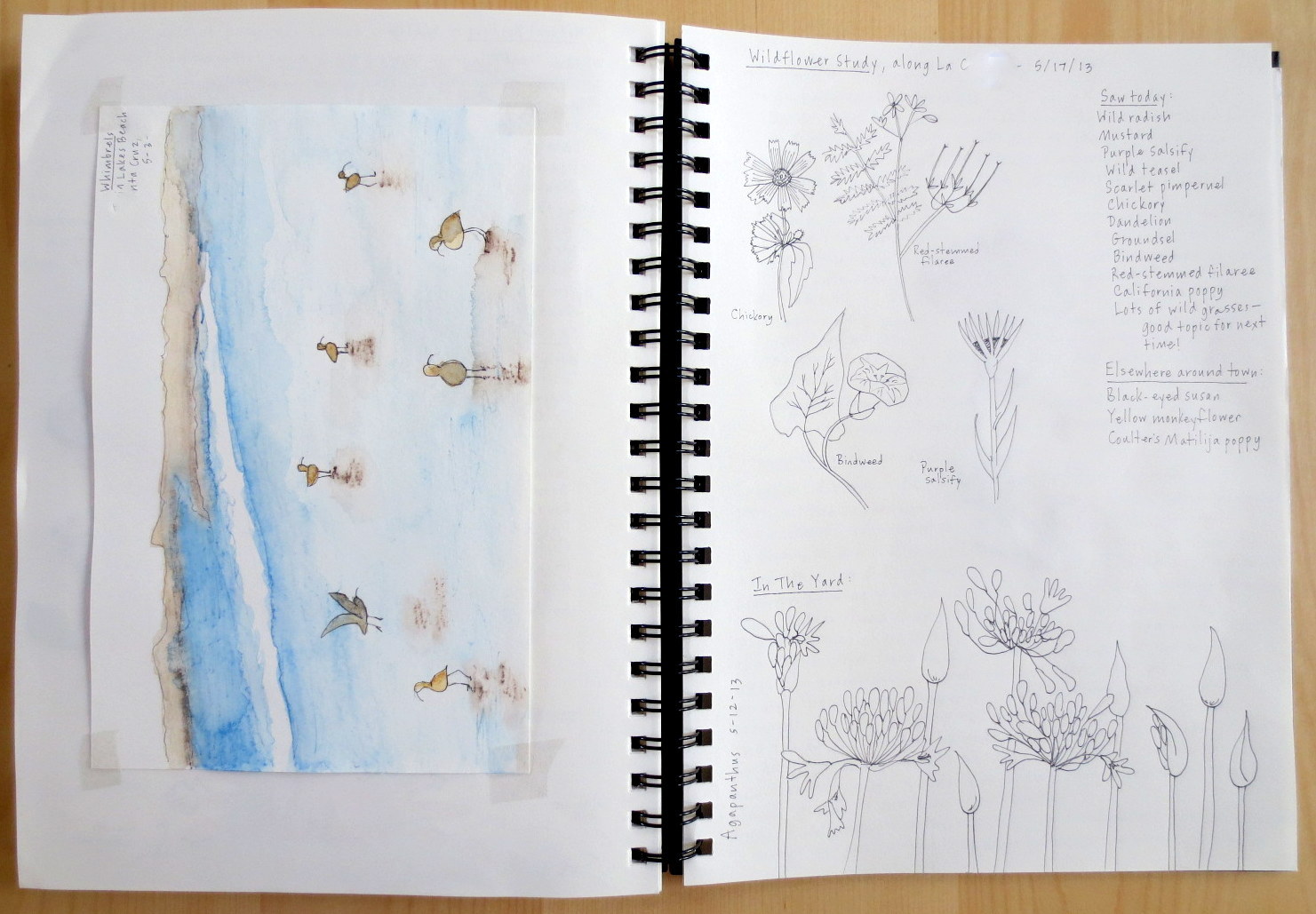
Jen invited us to share excerpts and photos from our own nature journals, and I'm planning to do so.  One of the most delightful parts of my week is Friday afternoon, when I sit down with my oldest three, our drawing supplies, our notebooks, and our nature tray and spend an hour or two capturing on paper the discoveries from our outing that morning.  If you've been reading this blog for any length of time, you know that nature study takes up a good chunk of my writing space here.  So I had lots of examples to pore through that I have posted here before, and I've chosen just a few to re-share.

Before I do that, I want to chat a bit about this chapter.  Last time I focused on the idea of whether e-notebooks can provide the same benefits of Keeping that Miss Mason promises.  I still can't answer that. ;) 

But I can say that I don't really think there is a digital comparison for a nature journal.  One can take lots of nature photos and arrange those photos into a useful record, the kind of record that the students in Miss Mason's schools were keeping for sightings of birds, wildflowers, and other signs of changing seasons.  Those photos can also be useful for identifying and for drawing from (we do this often).  One can keep narrative notes of one's nature walks in digital form and I don't think much is lost.  But photos and typed notes are distinct from drawings, which are a component of Miss Mason's nature notebook and require of the Keeper a different kind of observation and attention.  One also cannot keep pressed flowers or leaves in digital form, as Bestvater includes under nature scrapbooks in this section.  So a digital Nature Journal, though perhaps more useful and complete than a hand-Kept one in some ways, would not meet the full intentions that this category of Keeping carries.  (Or am I mistaken?  Let me know.  It's so valuable thinking all this through with others.)

~~~~


Now on to some examples from these labors of love in our home:

I love viewing my son and daughter's narrations of the same outing side by side.  It's so interesting to see the differences in what they focus on and how they process their discoveries.


And from a more recent outing:


A few from Mommy's nature journal:


And one from my preschooler's--her drawings are just darling and she is so very serious about getting things just as she sees them:


I was not a nature-lover as a child, nor have I ever considered myself a draw-er.  I determined, however, to get over my inhibitions and start a nature journal alongside my children when they started their formal schooling.  Since then, it has become a favorite hobby.  And my children, seeing me excited and inspired, have eagerly taken up the habit as well.  Even my preschooler loves to join in, drawing next to Mommy, looking up finds in field guides, and asking me to write down the nature walks she spontaneously narrates to me as the older children record their own observations in both word and drawing on the other side of the table.  Nature study is one of the highlights of our home education (something I never thought I would say a few years ago!).  And if there is hope for me, a girl born and living still in the midst of Silicon Valley suburbia, there is hope for you and your family as well. ;)

Thursday, February 6, 2014

The Living Page :: Chapter 1 and Some Thoughts on E-Keeping


I'm happy to be reading through Laurie Bestvater's The Living Page: Keeping Notebooks with Charlotte Mason.  The book was my Christmas gift to myself this year, but I hadn't had a chance to read it yet.

Jumping right in...

I will admit up front: I am not a paper lover.  

Well, that's not entirely true.  I love the idea of notebooks.  I love browsing and handling pretty paper.  I love the look of a fresh journal, soft blank pages ready to be written on.  I have kept diaries and commonplace books from time to time, and I currently keep a Calendar of Firsts and a nature journal, both of which I really enjoy.  I'm very particular about my pens and pencils.  I much prefer real books to electronic ones.  I like sketching and keep an art notebook.  I even dabble in calligraphy.  And reading through the notes and sketches of the great minds and artists are usually even more interesting to me than their most famous works.

And I consider myself a Keeper, in the intellectual way she means.  I thoroughly agree that rearranging, narrating, brooding over--these are all steps toward actually knowing.  I have always been drawn to lectio divina in my prayer life.  I find value in keeping notes of memories, books read, quotes loved.  I have learned more from the act of nature journaling than I ever expected to.  And I have already seen these practices bear fruit in my children's education.

But coupled with those tendencies, I hate clutter.  And I'm far more practical than sentimental.  So if I can somehow accomplish the same "keeping" without the clutter of notebooks, journals, and paper, paper, paper, I'm all for it.  That means that my journaling these days is done in a (very, very long) Word document, my lesson planning in a spreadsheet, my "note keeping" of all sorts in Evernote.  Baby books?  Each child has a spreadsheet charting their "firsts" and a file in the cabinet for the ephemera.  Photo albums?  We flip through folders of digital photos on the tablet when we want to reminisce.  The kids' art?  I display them for a while, then keep the few best and take photos of the rest before tossing them in the recycle.  I disposed of all my childhood journals when I got married and moved out.  After many years of being a die-hard fan of a particular agenda (the Quo Vadis Trinote, the closest thing to agenda perfection there is!), I went paperless and opted for Google Calendar.  My mental stability just can't stand clutter, and this is heightened because of the amounts of paper we have the potential to accumulate as a big (and growing!) family.  So paper has to prove itself as essential before it finds a place in my home.

~~

So I come to this book with an eager curiosity.  I have read quite a bit about Miss Mason's various notebooks, and we have incorporated several already into our schooling, based on the ages of my children, with much success.  I'm excited to learn more!

I'm convinced of several of Bestvater's premises right from the start:

:: Keeping is important.  Bestvater makes mention of the great minds that have been Keepers, and that's convincing.  But more convincing for me is my own experience over many years of writing-as-thinking, note-taking, various forms of journaling, and so on.  For me, the act of Keeping isn't in question--it's has been for me a path to knowledge, spiritual growth, and more.

:: Keeping is important for children.  This is her main focus in this book: the role Keeping can play in education.  I am a digital-friendly person, but my children decidedly are not.  They don't have any media exposure at all, in fact, so their Keeping is naturally paper-based, and I intend to keep them digital-free for now because I see the value in that practice for young ones.

:: Miss Mason does not suggest methods without good reason.  Bestvater quotes Miss Mason: "there is no part of a child's work at school that some philosophic principle does not underlie" (6).  I have found in the past few years of studying Miss Mason that to understand her methods is to understand the reasons behind her methods.  I try to be a CM purist when it comes to educational theory, so when I do have to make changes (and I sometimes do!), I try my best to ascertain her reason for the recommendation in the first place so that I can try to make a change that is still in keeping with the underlying principles.  My preference for e-Keeping is no different; if Miss Mason considers the physical notebook itself important, I would like to be sure I understand why before choosing a different path.

:: Physicality can matter.  In my religious upbringing, the physical nature of man simply wasn't important.  The Sacraments, bodily mortification and sacrifices offered up for the salvation of souls, the gestures and postures of the liturgy, the sacramentals, the sweetness of the chrism, the rising smoke of the incense--all of these things are distinctly Catholic, and I am so thankful for them as a convert.  I do not deny the importance of the physical nature of things.  And I'm open to being convinced that notebook-keeping should fall into this kind of category, where physicality matters.

~~

So my first thought when approaching this book is in line with Bestvater's stated focus: I'm looking forward to seeing how I can enhance my children's educational "paper postures" to take full advantage of the benefits of Keeping in Miss Mason's eyes.

But the second question I'm hoping to consider has more to do with my own practices: whether I can live by "paper ways" without a bunch of, well, paper.  This chapter had me coming at that question from a variety of angles:

:: What part of notebook-keeping is grounded in natural law: is it the notebook itself, or just the act of Keeping of it?  Is it the narrating, the copying, the rearranging?  Or is it something about the physical act of writing or drawing itself?  Is it the process or the product, or both?  Ms. Bestvater hints at this in Chapter 1: "is it not the Keeper's full human life that Mason esteems?  What if the emphasis is meant to be on the formative process--the growing person who feasts upon and then shares the Great Ideas in creating the art, rather than the artifact or achievement itself?" (12).

:: How much importance does the physicality of the notebook carry?  I have the feeling based on Ms. Bestvater's sweet retelling of the journal she and her aunt shared that there is something about the physical act of keeping that endows a moment, quote, person, thing with worthiness, as if the act of Keeping proclaims that the thing is important enough to be kept.  Does e-Keeping proclaim that importance in the same way?  Or does e-Keeping, in requiring the time but not the space, suggest that the things kept are not worthy of that space?  She writes of that time in her life: "But mostly what I carried away was the sense that I was important.  I had been taken seriously ... I knew that love notices" (15-16).

:: Is all Keeping created equal?  Are there some notebooks that might be replaced by less papery options?  Which have particular value in keeping as physical notebooks?  She talks about the fascinating combinations of arts and sciences in the journals of thinkers from DaVinci to Merian, and I haven't found a sufficient alternative to the noticing that physical drawing requires--which is why we do have nature journals here and can't imagine replacing them with a digital format.  But what about other kinds of notebooks?

:: What is the place of technology in Miss Mason's vision for notebooks?
Does e-keeping "nurture the science of relations and the art of mindfulness" sufficiently?  Can it bring us to the "school of Divinity" in the same way?  Ms. Bestvater mentions technology briefly a few times in this chapter, mostly as an alternative to notebook-keeping, but I wonder if the two can mesh.  After all, as she herself notes, we're enjoying the original journals of John Muir in digital form now, so there is a place for us to use technology as a way of getting at the great minds of others.  But what about our own Keeping?  Could there be a place for technology there too?

So put simply, is it the paper postures or the paper postures that Miss Mason feels are grounded in the natural laws of education?  I'm hoping to find out.