Showing posts with label Form I. Show all posts

Saturday, November 7, 2020

My Planning Tools for 2020-2021 :: Logbooks and Timetables

I have had some requests on Instagram to share a closer look at my logbook, so I thought I'd hop over here and pull together a post about my process this year. This is one of those topics it is much easier to blog about than to answer DMs about!

In the past, I have used different ways of organizing my plans, managing my days, and pre-reading. I have blogged about those strategies as well.

Here I'm going to share about what is working for us this year. Over the past couple years, I have changed my approach quite a bit -- and for the better! I have a few different tools I am using that have been very successful for us, even with seven students in three Forms and lots of littles alongside.

LOGBOOK

But for the past couple years, I have adopted the practice of a logbook, which is an idea straight from the PNEU that I have adapted for our family. Amy was the one who introduced me to the logbook -- she and I discussed the topic briefly over at Charlotte Mason Coast to Coast a couple years ago. (If you are a CMEC member, we went into logbooks in more depth during this year's Summer Planning Mini-Retreat, and we have plenty of examples on the Logbooks and Timetables page under Resources.)

Simply put, the logbook offers me a place to LOG the work we do in each lesson block and my reflections on that work (as needed).

This year, I am using two-page spreads for each 5-week session (half-term -- we do 10-week terms). Last year I tried to fit a full term on one spread and I didn't have enough room for notes, but the half-term seems to be just right.

I have spreads for Form 1 and 2 readings, Form 2 readings and work, Form 1 students, and family studies. This grid format allows me to see several weeks at a glance so that I can notice patterns, ongoing problems, and progress.


Here are a few filled-in examples from earlier this year:


I have my logbook open during the day so I can jot down notes as we go!

SCHOOL PLANNER

I also use my logbook for planning. I write up a weekly grid to work from based on each day's timetable, then sit down weekly to think through my plans for each slot.


blank and ready to go!

filled in for the week  (except special study -- I jot my plans there over the weekend)

I am doing less weekly pre-reading this year since I did so much over the summer. So I get out my pre-reading notebook to reference during this prep session, adding any important notes I have for myself and marking with a post-it any discussion points I want to bring up with my older kids during the week. (I just pull out my pre-reading notebook and work from there in those moments.)

My weekly prep time takes about an hour this year. I also do some related bedtime reading: the high school literature books, biographies, and religion reading that I didn't get to over the break.

At the end of each day, I look back over my plans and see what didn't get covered -- and I circle it. Sometimes I think we'll have time for an activity that we don't actually fit in the block. Sometimes we read a little less (or more!) than I had planned. I circle those things to remind me to consider them when I am making the next week's plans or to cover at Weekly Meeting, depending on what it is. (Sometimes I have a discussion point or side note I wanted to bring up with my high schoolers but forgot. That kind of thing I bring to Weekly Meeting on Friday to discuss there.)

This weekly grid is my brain during the week! I use it to direct my lessons for every Form, every day.

PRE-READING NOTEBOOK

I mentioned my pre-reading notebook above. I have shared about various ways I have kept my notes before.

This year, I had much more reading to do with the older kids in high school, so I decided to simplify my notebook practices. Instead of drawing and painting in my pre-reading commonplace and keeping another notebook with more logistical notes, I am just keeping one lined notebook this year for all of my notes. 

The first half has my book notes - main ideas, discussion points, ideas for lessons. 

The second half is a simple commonplace book -- just quotes.

I filled up most of this notebook over the summer, but there is still room for me to add for the books I am reading week by week or term by term.

This is now my reference book that I pull out weekly (at Weekly Meeting and my weekly planning time), whereas my logbook is my working notebook that I use daily.

In the past, my pre-reading notebook has been a creative project for me. But this year, I wanted to focus on commonplace-keeping and working in my Book of Centuries, so that is where I have been putting my reading-related notebook time.

LOGBOOKS FOR HIGH SCHOOLERS

My high school kids are actually keeping their own logbooks this year, so although I do keep my plans for them in my weekly spread, I do not log their work daily. I bought planners from Target that are set up with blank categories so that they could dedicate a column to each day of the week and just work down their timetable of subjects in order. I have them make note of Afternoon Occupations at the bottom of each column, and they have space on the side for them to make note of things they want to discuss at Weekly Meeting, goals for themselves, notes for online classes, etc. They have this logbook, their timetable, and their program, and they work through their days very independently! It has worked so smoothly for us.


Any notes that I want to keep about my high schoolers go right on my weekly spread (that right column has room for my general reflections). Or if there is an issue I need to troubleshoot, I just turn the page and brainstorm there! The notebook is set up like a bullet journal in that I don't have it all laid out in advance. This allows me a lot of flexibility in my record-keeping.

FAMILY TIMETABLES

I used to schedule our days to be very flexible, just carving out school blocks and fitting in whatever fit on a given day. I felt like that worked very well for the season I was in at the beginning, with more littles than school-aged kids. It also fit my personality -- I am one that tends to push too hard rather than not hard enough, so even though I didn't have a strict line-up for the day, we were always getting it all done. It was a good system for us.

But the past two years I have worked with a formal timetable for our lessons time and I LOVE it. I don't think I could school this many kids, have this many good conversations, hit all the "books and things," and still keep my sanity without it! I put a lot of thought into what our schedule should look like during the summer and then just follow it week by week. If I need to make a change -- if something isn't working or we want to try something new -- I just adjust it, print a new one, and go from there. I also review the timetable after each five weeks to see if it needs a refresh.

Since I have multiple Forms, I have a family timetable for each weekday. The stack is hung on the fridge and we flip to the right day each morning. 

My high schoolers each have their own timetable in their notebook. Their timetables are personal to them because they share books, so I often have them flip-flop subjects to accommodate that. But I still have them on our family chart so that I know roughly where they are in their day at any given time. And they join us for afternoon lessons, so I can see at a glance what time that will happen on any given day.

All that said, we do not always follow this exactly as scheduled. Right now, Emilia is napping in the morning and late afternoon and Damien naps mid-afternoon. So occasionally, I will swap the Form 1 and 2 kids' lesson block (12:30-3pm) and outside time -- we begin their line-up of lessons whenever she goes out and work straight for two hours. Then we pick back up when the older kids are scheduled to join us at around 2pm for our last few family subjects each day. But even when we change our beginning time, we still follow the order and length of these lessons, which keeps us all on track and ensures we have variety and balance!

The timetable takes away the effort of decision, holds me accountable, gives me peace in the moment, and helps our days with multiple students run smoothly. I don't have to think through whether one of my students will need a book while another student is already using it, or if I'll be available to hear a narration. All of that has been accommodated! And I can adjust during my reflection time when needed.

So that's a tour through my tools this year. Have you tried a logbook? Where do you like to keep your notes and thoughts for lessons, or your reflections on the day/term/year? I'd love to hear what methods work for you. :)

(And because I know you are going to ask: the robin's egg blue and navy notebooks below are hardcover XL classic moleskines in lined for the pre-reading notebook and dot grid for the logbook. I use my very favorite mechanical pencil, a black ballpoint, and a set of Staedtler Triplus Fineliners in these notebooks. There is some ghosting with the markers, but since I only use those to draw my grids (and opt for light colors anyway), I am fine with that. Pencil and ballpoint work fine on these thin pages, though. The thinness of the pages allows for a LOT of pages in just one small notebook, which I really like for this purpose. Links above are affiliate links. Thanks for your support!)

Wednesday, June 27, 2018

Form I in Our Home :: 2017-2018 in Review

First: if you would like to know more about what a Form I rotation is, please click over and check out my post from last year! I have links there to several great posts on the topic from other AmblesideOnline moms as well.

This year's Form I rotation involved the same two students as last year: third-grader Cate and second-grader Xavier.  (Next year, Cate will move into Form II and Bridget will join Xavier for a new Form I combo of students!)


Since this rotation started with Cate, this year's selections were mostly from AmblesideOnline's Year 3 readings. I combine everything I can, leaving history and history-related literature separate (which means Xavier was doing history and some literature selections from AmblesideOnline Year 2). They also do math and copywork individually too, based on ability level and at their own pace.


Cate and Xavier are not yet reading their school books on their own, though both of them took off in their reading skills last summer (and I anticipate them reading quite a bit on their own next year :)). With the combination of that and it being a Baby Year, I really needed to find some ways of simplifying my read-aloud schedule. So we did several books on audio this year: This Country of Ours and Our Island Story (via Librivox) for both students was on audio. They follow along in the book and come to me to narrate immediately afterward. For longer chapters, I tell them where to pause the audio, and they come to me to narrate in the middle once or twice.


I read aloud Natural History, Geography, and Literature. Cate and I buddy-read her History Tales, and she read independently a couple of her religion books.


I made very few changes to the AmblesideOnline schedule. I cut Parables from Nature and Trial and Triumph to accommodate our religion readings. I also added religion selections for Cate specifically to highlight the untold Catholic history of the Renaissance and Reformation period. She read the Vision biographies of St. Thomas More and St. Edmund Campion, as well as Crossbows and Crucifixesa free read, and I edited Our Island Story judiciously for bias surrounding this time period. (I still think it's a great book. :))

Religion readings included First Communion prep for Xavier (and Bridget, my kindergartener -- they received together just a couple weeks ago!) and My Path to Heaven for Cate.

They did experiments from The World in a Drop of Water with their Year 6 siblings

We did nature study with our weekly group, which is a joy as always. Cate and Xavier both became fairly proficient with their watercolor kits this year. They also did weekly challenges from The Laws Guide to Nature Drawing and Journaling with their older siblings (and me!) in Terms 2 and 3. That included activities like making a map of our nature walk, doing some object lessons on wildflowers following the Laws' question prompts, recording a nature event, and other journal-stretching, observation-building exercises.


Handicrafts were time spent with older siblings. Cate learned to sew Felt Wee Folk with Gianna in Term 2 and did that plus beginning embroidery in Term 3. Xavier went through The Art of Chinese Paper Folding and My First Book of Knots with Vincent in Terms 2 and 3, starting with the easiest projects. They also learned quite a bit about baby care. ;)


They both took piano and art weekly all year, and had weekly swim lessons in the spring. Other than that, we had no regular commitments out of the home other than church.

Cate and Xavier are both enthusiastic notebook keepers. Cate really came into her own this year by requesting to do her own writing for her notebooks. I am not requiring written narrations from her yet in Year 3, but she doesn't realize that this is what she was doing! I still wrote narrations for Xavier into his notebooks, and he added his own illustrations and diagrams and such. They enjoyed working together on these keeping exercises, and I love seeing their personalities shine through as I look at their work side by side. They kept a Pagoo notebook (in Term 1-2), a Secrets of the Woods notebook (in Term 2-3), a map for Marco Polo, and a binder timeline.  They also chose to keep a little map for Tall Tales, which I thought was so cute.


she added flaps to the busiest centuries -- LOL


They also loved their Weekly Paintings. (A couple times during the year, they even chose the same subject to memorialize! :))


They worked through RightStart Level C and Level D at their own pace.

Cate began cursive this year using a small workbook for letter formation. She also began a Prose and Poetry book and a Reading Log like her older siblings. Xavier continued working on his printing by copying poetry of his choice with Startwrite pages.

They both wanted checklists even though very little of their work is independent at this point! I obliged because I think the habit is a good one to instill and because it kept our home routines and chores humming along.

Cate wanted hers very detailed -- everything she is responsible for, all in one place, with circles to bubble in "like the Big Kids." I made Xavier's simpler but still comprehensive. Different personalities! :)


And a quick description of their school day:

: Morning Block - First thing in the morning, I spend about 40 minutes between the two of them: about 15 minutes of math and 5 minutes of copywork with one, then the other.

:: Morning Basket - Our family work, including poetry, Bible, and religion.

:: Independent Work (Cate) - Cate does a reading either on her own or on audio right after breakfast, then comes to me to narrate before she heads outside for playtime.

:: Naptime School - I spend the first hour of naptime working with my Form I students.  That usually works out to one reading for my Form I students together, a keeping activity, and then one reading with just my Year 2 student. While I work with Xavier, Cate is usually working on something independently from her checklist or drawing. I bring them back at the end of the second hour of Naptime School to join us for the rest of our family work: Italian, composer study, picture study, rectiation, etc.

:: Afternoon Occupations - This block includes handicrafts since they did that subject with older siblings rather than with me this year. They also do piano practice and art in the afternoons, as well as finishing up chores and optional notebook work. (I'll have a few posts up about their chore routine soon, but you can see prior year's here.)

For more about our Family Subjects, see my write-up of my Year 6 students' work and scroll down. Our family subjects diverge from AmblesideOnline's selections since I am combining for so many children. We are kind of on our own rotation through those. :)

~~~

Hope that helps those of you managing multiple early elementary students in your home like we are!

Wednesday, May 17, 2017

A School Year Kept

As a look back on our school year, I want to share a bit of our formal keeping from this past year.

My Year 5 students kept three special notebooks in addition to their nature journals (which I share photos of every so often anyway and won't include here): their History Notebook, their Science Notebook, and their Prose and Poetry Notebook.

In my post on our School Plans for this year, I detailed the way we would be using these books -- frequency, purpose, format, and so on.  (Here are my write-ups for Year 5 and Form I.)  So I'll share a short description here, but for more information, head over there.  And then if you have further questions, ask away!

From my Year 5 Students

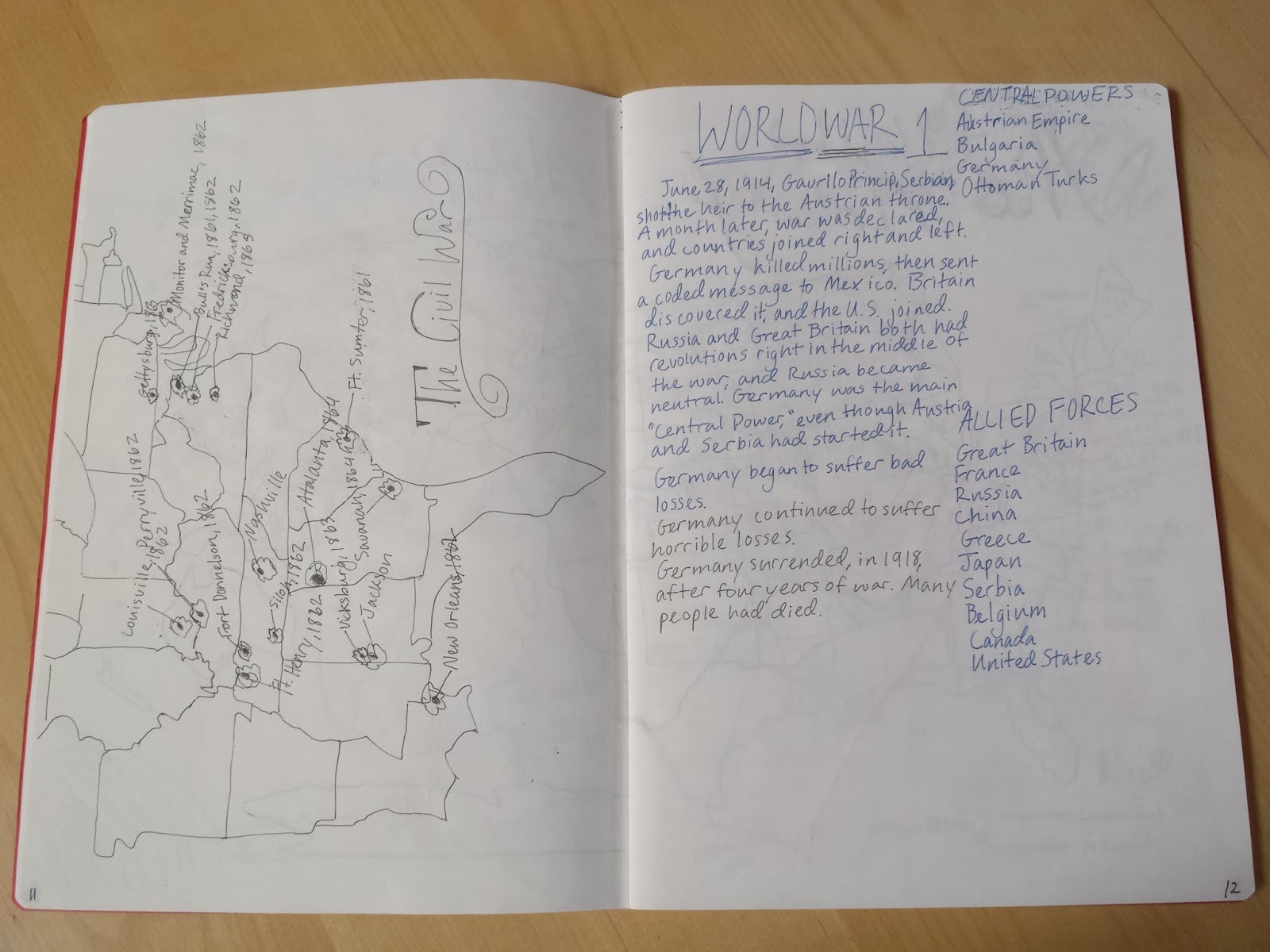
Their history notebooks contain their written narrations for the year in that subject (both for This Country of Ours and their historical biography in Term 3), as well as mapwork, lists, charts, and other keeping they chose to do.

The first half of the photos belong to Vincent and the second to Gianna.  As you can see, they have very different styles and their individual strengths and interests shine through in their notebooks, which is why Charlotte Mason-style notebooking is different than other more cookie-cutter, static forms.

(By the way, the pictures below feature the EcoQua notebooks I bought for our Year 5 keeping. We love them and will definitely be using them in the future.)


Their science notebooks were simpler, holding only their weekly written narration for that subject:


Their Prose and Poetry Notebooks, which are basically a precursor to a commonplace book, are below. They wrote in this notebook in lieu of copywork for ten minutes weekly.  They were able to choose their selection.  Interestingly, both chose to include large amounts of Hiawatha, which we read in Term 2.  But the rest was a mish-mash of poetry, famous speeches, bits from Kim and Shakespeare, and more.


All three of these notebooks will continue into next year.  The History Notebook will be used in Term 1 before we move into a proper Book of Centuries with the new history rotation in Term 2.  Their Science and Prose and Poetry Notebooks are about half-full and will continue to hold their work for those subjects.

From my Form I students

Cate in Year 2 and Xavier in Year 1 had simple keeping on their weekly schedule: an entry in their binder timeline and on their current map.


They also had the option of making animal cards to go along with the Burgess Animal Book, which they opted to do just about every week, and that they did independently.  At the end of the year, we made those into a little book for each of them.


And from me!

I kept a few things alongside my Year 5 kids this year: a world map, a United States map, and a century chart. These were very educative to work on -- and also quite fun!


I also always keep one commonplace book dedicated to school readings, and Year 5 featured very prominently in that this year -- Halliburton, Kipling, Dickens, Helen Keller, John Muir...


In addition to these examples above and to our individual nature journals, we keep two collections as a family: a Calendar of Firsts and a Family Poetry Notebook.  They are both housed in the same binder.

We began keeping our Calendar of Firsts back in 2013, so this is our fourth year of data!


And our poetry notebook are all of the poems each child has learned, illustrated and added to the pile.  We began that when Gianna and Vincent were in kindergarten and have dozens and dozens of poems included now.


That is a look at our year on paper!