Showing posts sorted by relevance for query calendar of firsts. Sort by date Show all posts

Tuesday, April 9, 2013

Calender of Firsts - The After!


As I promised earlier this week, I have some "after" shots of our Calendar of Firsts to share.  Now, in thinking and reading about the topic, I came up with quite a few different options for organizing entries:
:: By date - Each date is given a line or column, and you can chart each "first" under the appropriate date.  Entries made in different years can be designated by pen color, or the year can be noted.
:: By sight - Each expected sight could be given a space: "First Daffodil," "First Blossoms," "First Red Leaf on the Maple," etc.  (This would be a particularly good option if one was focusing on firsts only in one's own yard.)
:: By month - Each month is given a spread of one or several pages, where notes can be made as needed.  Divisions might be made for each week of the month (Week 1 of August, Week 2 of August, etc.), or for each year (August 2013, August 2014, etc.), or it could be left blank to fill in as desired.
:: By year - A spread of pages for each year: 2013, 2014, 2015, etc.  Divisions could be made for each month or each week of the year, forming a kind of grid, or sightings could be kept as a running column, or it could all be more free-form.

I think all of these configurations could be useful depending on your goals--hence the perfectionist paralysis. ;)  In the end, though, I went with monthly spreads, and I decided to privilege flexibility over clarity, I suppose, in making my calendar basically full of blank pages.  I like blank pages--I like the possibility of changing my format year to year without having to start a new calendar.  


So for this first part of April, for example, I have a few specific dates noted: 
April 8 - first purple blooms on the boxwood hebe
April 9 - inch-round fruits on the plum tree

But I also have some more general season observations of things seen around the yard/neighborhood during my run last Saturday morning: 
In bloom around town - day lilies, hyacinths, wisteria  
Wildflowers - wild radish, mustard, winter vetch, poppies, dandelions, sorrel

I think this combination of dates and lists will be the most useful to us.  It suppose it makes this notebook less a Calendar of Firsts and more just a nature calendar in general...but I do hope to spot lots of firsts to note!  And I have to admit that being obligated to note just "firsts" makes me nervous--what if I miss something? :)  I also plan to keep it somewhat organized, working from the left so that there are implied columns for each year.  But not actually drawing the columns allows me more or less room to write, as needed.  I can also sandwich extra blank pages between the month-title page and month-image page in years ahead.


The format itself was simple: large-type month on the left-hand side and a seasonally-appropriate image on the right.  I printed all of it on cardstock for durability and popped them into the binder I had originally purposed for our memory work (which found a new home on Evernote).  It now lives on the shelf with our nature journals, ready to pull out as needed.

And speaking of Evernote, yes, I did contemplate just making a Calendar of Firsts in Evernote--you know I'm a devotee!  But in the end, I wanted my children to be able to page through it and add entries, and they aren't allowed on the computer yet, so hard-copy seemed the way to go for this project.

I also decided to combine this project with another little something I've been meaning to start more formally: some life lists.  


So at the back of the Calendar of Firsts, I printed out some blank forms for us to keep track with: birds, animals, insects, trees, shrubs, wildflowers, and so on.  I know birding life lists are common, but I have also found myself noting in the back of my nature journal (more scrawled lists!) various wildflowers I have spotted, trees I have identified locally, and so on.  So now these notes will have a more formal home--and hopefully will be in a more useful format.  Again, favoring flexibility, I decided to print these one-sided, leaving the back side of each page for further notes about species, descriptions of our sightings, sketches, or whatever else we may find useful to add. (Actually, I'm still trying to figure out what categories will make the most sense for us.  Right now, I have Trees and Shrubs, Wildflowers, Birds, Mammals, Invertebrates, Water Creatures, Reptiles, Rocks and Shells, Other Sightings, and In the Garden, which I'm planning to use for cut flower varieties and whatnot.  Shells probably would have made more sense in the Water Creatures section, but we don't usually find the creatures--just their shells--and we keep our shell collection with our rocks.  And should I make a separate page for "Moss, Lichen, and Fungi"?  Haven't decided yet.  So I may reorganize some of the lesser categories.  But this is good enough.)


Oh, and I have written about the horticultural map of our yard we have been working on--it's here too!  This binder seemed like the perfect place to keep a formal record of this project.  I drew a blank map of our front and back yard, photocopied them onto cardstock, and put them at the back of the binder to fill in by hand as I go along.  I'm happy to say that I have almost finished labeling all the plants on our property!  That's not saying much, I suppose--we have quite a small lot. ;)  But when we moved here, I didn't recognize hardly any of the plants, and this project has never been a top priority, so it's nice to see my slow-and-steady progress actually get me across the finish line!  Having it here, accessible to the children, makes it a field guide of sorts for them as they start to put names to the "faces" in our yard.  I'm hoping they become good friends. :)

I'm planning to use that blank pages opposite each map to make notes--when each plants bloom, other common names, gardening notes, and so on.

So now that this is up and running, I'll busy myself with populating the life lists with what we have seen already and with thinking more about the best way to categorize these sights.  If you have comments or suggestions, please do share.  As I said, the format I'm using allows me to reorganize and rethink the ways I'm keeping track of information, so I'm always open to suggestions.

Happy Hunting for Firsts!

** Edited to add - I've had quite a few email requests for my template, so I uploaded it to share.  Feel free to download Our Nature Calendar for use in your own homes--especially if you're on the West Coast, since I included images that are familiar to us locals.

Tuesday, March 3, 2015

Keeping Company :: March Invitation

Have you all checked out the February Keeping Company link-up lately?  So much inspiration both for those of us already Keeping and those itching to start.  Please do go and take a look!

Monthly Feature

This month, I'd like to spotlight some ideas from Hwee at the Tiger Chronicle, who shared Foreigners are Everywhere.  She and her family have committed to keeping "firsts" this year, and they are doing a wonderful job!

I so enjoy reading her nature study observations and then seeing how those observations get put onto the page.  On their rural (and not-so-rural) walks lately, they have made lots of nature discoveries.  From squirrels and deer to a few foreign finds...


You'll have to click over to read the details!  And while you're there, you'll see examples from her and her son's nature Keeping.  I particularly admire her melding of Book of Firsts and nature journal--both lovely and functional.

Speaking of, spring officially begins this month!  (Or autumn, for all of you down under. :))  The change in seasons makes this a great time to start a Book of Firsts if you haven't already.  It can be as simple as notes scrawled in the back of your nature journal, or you can grab a pre-dated agenda (like Hwee has!), or you can make a mostly-blank "nature calendar" like I did a couple years ago.


The Handbook of Nature Study blog newsletter for this month featured our family's Calendar of Firsts, so if you want to read more about how we set it up, go and download your copy of the March newsletter.  (I also have our format available as a free download.)  And in the newsletter, Barb has a chart format available to print, if you prefer that.  So many easy options--just print and begin recording!

I know several of you have already begun Keeping firsts this year in one form or another, so...


For this month's optional prompt

Share a peek into your Book of Firsts!  How is yours arranged?  Is it a family or personal project?
If you have been keeping one for a while, how has your Calendar of Firsts made a difference in your nature studies?  If you're just beginning, what sights have you noted so far this late winter?


I'll be back here next Tuesday, March 10th, to post the link-up.  In the meantime, the February link-up will still be active until then, so feel free to continue sharing your posts there.

Sunday, April 7, 2013

Calendar of Firsts - The Before


Earlier this year, I had grand plans to start a Calendar of Firsts at the turn of the new year.  Here's what mine looks like right now:


Isn't it lovely?  ;)  No, a scrawled list of random sightings on scratch paper stuffed into my nature journal isn't quite what I had in mind!  But Christmas preparations and celebrating got the best of me, and I never had a chance to think through the format options and begin one in earnest before January arrived.  I too often fall into the trap of what I lovingly think of as perfectionist paralysis, which, in my head sounds a little something like this: "What format is best?  A binder?  A notebook?  A desk calendar?  A virtual calendar?  And how should I organize it all?  By month?  By sighting?  By date?  I want to get it just right--I'll be using this for years!!!!"  Cue many months of thinking and researching, with very little to show for it.  Does this happen to you too, or is it just me? :) 
 
And then I remind myself, "Perfection is the enemy of the good."  So I keep scribbling a few notes as I see "firsts" outdoors, and I vow to just start something by spring.  Well, spring is here!  And a recent conversation on the Ambleside Online forums reminded me of this to-do.  So I'll be back very soon with a little transformation of this jumbled list into a maybe-not-perfect-but-good-enough Calendar of Firsts.

Friday, January 30, 2015

Scheduling Family Keeping

One question I asked in the January prompt for Keeping Company concerns scheduling: do you schedule your Keeping or has it already become a part of the family culture?  

For us, it's a bit of both.  I schedule our Keeping, even my own.  I do not do this because it's a chore for me--not at all.  I do it because sometimes it just doesn't feel like I have time to sit down and write in my commonplace or to sit down and paint in my nature journal.  (Sitting down without small people crawling on me is very rare here.  In fact, I often type these posts standing with a baby on my back! ;))  

But if it's on my schedule, it's a reminder to me that I do need to take that time--not because I don't want to, but because I do.  I pencil it in, just as I might a date night with my husband or a run with a friend.  I know the time out or the exercise is good for me, is needed for my mental or physical health, but if those activities don't have a place on my calendar, they're the first to go when a busy week rolls around.  The daily tasks of life have the tendency to engulf seemingly-frivolous pleasures if we don't guard them.  

So yes, to take the analogy further, my notebooks are much-loved companions, and I schedule dates with them to make sure I get some one-on-one time without the kids interrupting! ;)

That said, I don't tie my Keeping to a particular day or time, and I only schedule what I consider my personal minimum--the least I need to spend to feel like I got that intellectual Mother Culture time in.  Any Keeping I do beyond that is bonus.


Here are my personal minimums:

:: Weekly nature journal entry - We spend a morning each week on a nature study outing, and if the baby goes down for his nap when the toddlers do after we get home, I sit down and journal along with my kids.  If not (and more often than not right now, their naps do not overlap), I put our tray away for the day and pull it out on the weekend, when Daddy is home to watch the little ones.  Sitting down with watercolors is one of my favorite ways to spend a Sunday afternoon!

:: Weekly commonplace session - While I'm reading, I mark with post-its or dog-ear pages with quotes that I want to add to my commonplace book.  At least once a week, I spend some time transferring those quotes.

:: Weekly Calendar of Firsts and Life Lists review - This one we actually do as a family, but it's on my to-do list rather than my kids' since I'm the one that pulls it out and makes the entries.  Every week when my kids are doing their nature journals, we consider whether we have anything we'd like to add to our Nature Binder, which includes both our Calendar of Firsts and our Life Lists.  (As I've mentioned before, we keep ours more as a Nature Calendar than a true Calendar of Firsts, simply so that we can add a variety of seasonal observations.)  We usually have some notes to add each week, but not always.  I at least check in weekly, though.

My kids' routine looks slightly different:

:: Weekly nature journal entry - They are free to add whatever they would like from observations over the course of the week and particularly from our weekly outing.  They usually complete a page each week of notes and illustrations, probably because that is about what I do. :)

:: Five minutes copywork into their commonplace twice a week - This year is the first year my big kids are keeping a commonplace, which I call their "copybook."  Right now they have penmanship practice in both cursive and printing, so we alternate between the two, five minutes daily.  In cursive, we're still working on letter and word formation, so they do that on pre-printed practice sheets.  But for printing, they are now choosing sentences and passages from their school reading to copy.  They love choosing their own copywork, and they also love copying it into a book instead of on looseleaf print-outs.

:: Weekly mapwork entry - We have maps going of Europe, Asia, and the Holy Land this year, and they trace journeys and mark places read about in our readings.  We pull out the maps at least once a week to make additions.  This year, their work is more practical than lovely, but I hope to combine the two next year and make our map-Keeping an art project of sorts.

:: Weekly timeline entry - They each have a binder timeline that they have been adding to since Year 1.  At least once a week, they pull out their timelines and add any new figures or events that they choose.

(And just a note: my kids aren't old enough to have a Book of Centuries yet, but when they are, that will be a once-weekly task for us both as well.)

My personal goals get listed on my weekly planner...


...and my kids' goals are on our weekly schedule sheet.


So that's just how it works best at our house.  In the (far, far) future, I imagine I'll have free hours to fill however I like.  I'll take day-long hikes with my journal and watercolors, and I'll fritter away many an afternoon with a book and my commonplace by my side.  These are not those days. ;)  But I can still make a commitment to myself to carve out some moments of Keeping on my calendar and, at the same time, encourage my children in those habits.

Thursday, February 6, 2014

The Living Page :: Chapter 1 and Some Thoughts on E-Keeping


I'm happy to be reading through Laurie Bestvater's The Living Page: Keeping Notebooks with Charlotte Mason.  The book was my Christmas gift to myself this year, but I hadn't had a chance to read it yet.

Jumping right in...

I will admit up front: I am not a paper lover.  

Well, that's not entirely true.  I love the idea of notebooks.  I love browsing and handling pretty paper.  I love the look of a fresh journal, soft blank pages ready to be written on.  I have kept diaries and commonplace books from time to time, and I currently keep a Calendar of Firsts and a nature journal, both of which I really enjoy.  I'm very particular about my pens and pencils.  I much prefer real books to electronic ones.  I like sketching and keep an art notebook.  I even dabble in calligraphy.  And reading through the notes and sketches of the great minds and artists are usually even more interesting to me than their most famous works.
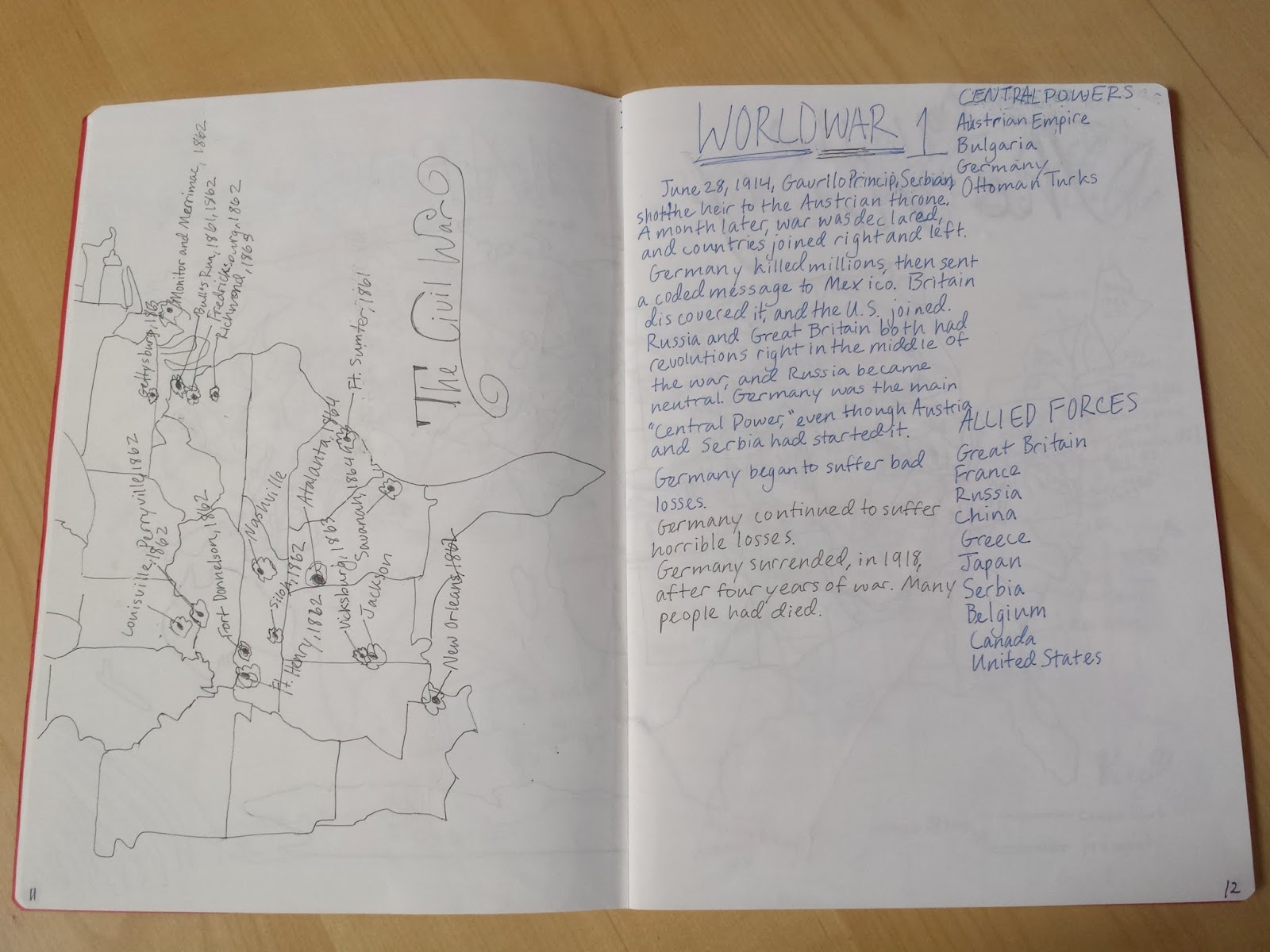
And I consider myself a Keeper, in the intellectual way she means.  I thoroughly agree that rearranging, narrating, brooding over--these are all steps toward actually knowing.  I have always been drawn to lectio divina in my prayer life.  I find value in keeping notes of memories, books read, quotes loved.  I have learned more from the act of nature journaling than I ever expected to.  And I have already seen these practices bear fruit in my children's education.

But coupled with those tendencies, I hate clutter.  And I'm far more practical than sentimental.  So if I can somehow accomplish the same "keeping" without the clutter of notebooks, journals, and paper, paper, paper, I'm all for it.  That means that my journaling these days is done in a (very, very long) Word document, my lesson planning in a spreadsheet, my "note keeping" of all sorts in Evernote.  Baby books?  Each child has a spreadsheet charting their "firsts" and a file in the cabinet for the ephemera.  Photo albums?  We flip through folders of digital photos on the tablet when we want to reminisce.  The kids' art?  I display them for a while, then keep the few best and take photos of the rest before tossing them in the recycle.  I disposed of all my childhood journals when I got married and moved out.  After many years of being a die-hard fan of a particular agenda (the Quo Vadis Trinote, the closest thing to agenda perfection there is!), I went paperless and opted for Google Calendar.  My mental stability just can't stand clutter, and this is heightened because of the amounts of paper we have the potential to accumulate as a big (and growing!) family.  So paper has to prove itself as essential before it finds a place in my home.

~~

So I come to this book with an eager curiosity.  I have read quite a bit about Miss Mason's various notebooks, and we have incorporated several already into our schooling, based on the ages of my children, with much success.  I'm excited to learn more!

I'm convinced of several of Bestvater's premises right from the start:

:: Keeping is important.  Bestvater makes mention of the great minds that have been Keepers, and that's convincing.  But more convincing for me is my own experience over many years of writing-as-thinking, note-taking, various forms of journaling, and so on.  For me, the act of Keeping isn't in question--it's has been for me a path to knowledge, spiritual growth, and more.

:: Keeping is important for children.  This is her main focus in this book: the role Keeping can play in education.  I am a digital-friendly person, but my children decidedly are not.  They don't have any media exposure at all, in fact, so their Keeping is naturally paper-based, and I intend to keep them digital-free for now because I see the value in that practice for young ones.

:: Miss Mason does not suggest methods without good reason.  Bestvater quotes Miss Mason: "there is no part of a child's work at school that some philosophic principle does not underlie" (6).  I have found in the past few years of studying Miss Mason that to understand her methods is to understand the reasons behind her methods.  I try to be a CM purist when it comes to educational theory, so when I do have to make changes (and I sometimes do!), I try my best to ascertain her reason for the recommendation in the first place so that I can try to make a change that is still in keeping with the underlying principles.  My preference for e-Keeping is no different; if Miss Mason considers the physical notebook itself important, I would like to be sure I understand why before choosing a different path.

:: Physicality can matter.  In my religious upbringing, the physical nature of man simply wasn't important.  The Sacraments, bodily mortification and sacrifices offered up for the salvation of souls, the gestures and postures of the liturgy, the sacramentals, the sweetness of the chrism, the rising smoke of the incense--all of these things are distinctly Catholic, and I am so thankful for them as a convert.  I do not deny the importance of the physical nature of things.  And I'm open to being convinced that notebook-keeping should fall into this kind of category, where physicality matters.

~~

So my first thought when approaching this book is in line with Bestvater's stated focus: I'm looking forward to seeing how I can enhance my children's educational "paper postures" to take full advantage of the benefits of Keeping in Miss Mason's eyes.

But the second question I'm hoping to consider has more to do with my own practices: whether I can live by "paper ways" without a bunch of, well, paper.  This chapter had me coming at that question from a variety of angles:

:: What part of notebook-keeping is grounded in natural law: is it the notebook itself, or just the act of Keeping of it?  Is it the narrating, the copying, the rearranging?  Or is it something about the physical act of writing or drawing itself?  Is it the process or the product, or both?  Ms. Bestvater hints at this in Chapter 1: "is it not the Keeper's full human life that Mason esteems?  What if the emphasis is meant to be on the formative process--the growing person who feasts upon and then shares the Great Ideas in creating the art, rather than the artifact or achievement itself?" (12).

:: How much importance does the physicality of the notebook carry?  I have the feeling based on Ms. Bestvater's sweet retelling of the journal she and her aunt shared that there is something about the physical act of keeping that endows a moment, quote, person, thing with worthiness, as if the act of Keeping proclaims that the thing is important enough to be kept.  Does e-Keeping proclaim that importance in the same way?  Or does e-Keeping, in requiring the time but not the space, suggest that the things kept are not worthy of that space?  She writes of that time in her life: "But mostly what I carried away was the sense that I was important.  I had been taken seriously ... I knew that love notices" (15-16).

:: Is all Keeping created equal?  Are there some notebooks that might be replaced by less papery options?  Which have particular value in keeping as physical notebooks?  She talks about the fascinating combinations of arts and sciences in the journals of thinkers from DaVinci to Merian, and I haven't found a sufficient alternative to the noticing that physical drawing requires--which is why we do have nature journals here and can't imagine replacing them with a digital format.  But what about other kinds of notebooks?

:: What is the place of technology in Miss Mason's vision for notebooks?
Does e-keeping "nurture the science of relations and the art of mindfulness" sufficiently?  Can it bring us to the "school of Divinity" in the same way?  Ms. Bestvater mentions technology briefly a few times in this chapter, mostly as an alternative to notebook-keeping, but I wonder if the two can mesh.  After all, as she herself notes, we're enjoying the original journals of John Muir in digital form now, so there is a place for us to use technology as a way of getting at the great minds of others.  But what about our own Keeping?  Could there be a place for technology there too?

So put simply, is it the paper postures or the paper postures that Miss Mason feels are grounded in the natural laws of education?  I'm hoping to find out.

Thursday, March 3, 2016

Nature Study Outing :: First Wildflowers and Early-Leafers


Our last couple nature outings have been taken over by the wildflowers.  And it's no wonder: we're having so much fun spotting our "old friends" again, whom we haven't seen since last spring.

We're making careful notes in our Calendar of Firsts--we're on our fourth year of data and it's getting really interesting to compare year by year.  Each season adds a new layer to our understanding of the changes in this area.  People always say that here in California, we don't have seasons.  But as a native Californian, I know we do.  We just have to be a bit more attentive!  Careful keeping of our Calendar of Firsts and nature journals help us to do that.

Like I said before, February starts "green season" here in California--that means early leafers and first wildflowers.  Here is a bit of a mish-mash of some favorite finds from the past couple weeks...

Plenty of vetch leaves cover the ground, but no blossoms yet.  This is one of my favorites, so I'm waiting eagerly for them to pop up!


Mustard and fiddlenecks are responsible for all the yellow around here.


Henbit, aka Giraffe head. (The perfect name for this guy, right?)


Sweet shepherd's purse with its heart-shaped leaves is always up by Valentine's Day here.


Wild cucumber leaves, blossoms, tendrils, and immature seed balls.  It loves to intertwine with the very-plentiful poison oak around here, so we have to beware.


It's not as common now for us to find one we're not familiar with, so it's always a real treat when we do.  This one I had never seen before.  It's called Persian Speedwell, which somehow sounds like a Bond girl to me?  Ha.  The tiny striped blooms are a pretty shade of blue.


This next one is blurry, but I couldn't leave out the other new flower we found: purple nightshade.  Cate said the middles (with their banana-like stamens and prominent pistil) look like pumpkins.  I agree!  There were two lone clumps of this, and I haven't seen it anywhere else nearby.


The wisteria--not a wildflower but beautiful all the same.  We always catch it when it's already in bloom, so I hadn't seen how the flowers are partially enclosed in a kind of casing and then unfurl.  The shapes and textures in this stage are so interesting.


When we get home from an outing like this, I prepare a nature tray for our journaling session.  The kids love to help me label it.  Here's ours from last week...


You can see a couple of the early leafers there on the tray: the willows that line our pond have both new leaves and small catkins, and the California sycamores have tiny velvet leaves and seed balls that hang in a line (which, I believe, distinguishes it from the American sycamore).

my willow sprig sketched and ready for painting
Since wildflowers are so small and delicate, I took the opportunity to talk with my kids once again about slowing down, observing, and trying to attend to the little details that make each one unique during our journaling session.  They made lots of little discoveries as they were drawing and did slow, deliberate work.  (Gianna's on the left, and my kindergartener's on the right--he really did a great job paying close attention and being true to the flowers he chose to draw.)


And it's not all journals and wildflowers!  There's lots of romping, building, climbing, and more going on when we get together...

not all the kids, but a good bunch of them!

I'm desperate to take the kids to some spots on my running trail because I noticed last weekend that the first lupines and vetch are in bloom, and I've heard there are shooting stars just around the bend of my usual route.  I'm thinking that's where we'll head next week!

Wednesday, May 17, 2017

A School Year Kept

As a look back on our school year, I want to share a bit of our formal keeping from this past year.

My Year 5 students kept three special notebooks in addition to their nature journals (which I share photos of every so often anyway and won't include here): their History Notebook, their Science Notebook, and their Prose and Poetry Notebook.

In my post on our School Plans for this year, I detailed the way we would be using these books -- frequency, purpose, format, and so on.  (Here are my write-ups for Year 5 and Form I.)  So I'll share a short description here, but for more information, head over there.  And then if you have further questions, ask away!

From my Year 5 Students

Their history notebooks contain their written narrations for the year in that subject (both for This Country of Ours and their historical biography in Term 3), as well as mapwork, lists, charts, and other keeping they chose to do.

The first half of the photos belong to Vincent and the second to Gianna.  As you can see, they have very different styles and their individual strengths and interests shine through in their notebooks, which is why Charlotte Mason-style notebooking is different than other more cookie-cutter, static forms.

(By the way, the pictures below feature the EcoQua notebooks I bought for our Year 5 keeping. We love them and will definitely be using them in the future.)


Their science notebooks were simpler, holding only their weekly written narration for that subject:


Their Prose and Poetry Notebooks, which are basically a precursor to a commonplace book, are below. They wrote in this notebook in lieu of copywork for ten minutes weekly.  They were able to choose their selection.  Interestingly, both chose to include large amounts of Hiawatha, which we read in Term 2.  But the rest was a mish-mash of poetry, famous speeches, bits from Kim and Shakespeare, and more.


All three of these notebooks will continue into next year.  The History Notebook will be used in Term 1 before we move into a proper Book of Centuries with the new history rotation in Term 2.  Their Science and Prose and Poetry Notebooks are about half-full and will continue to hold their work for those subjects.

From my Form I students

Cate in Year 2 and Xavier in Year 1 had simple keeping on their weekly schedule: an entry in their binder timeline and on their current map.


They also had the option of making animal cards to go along with the Burgess Animal Book, which they opted to do just about every week, and that they did independently.  At the end of the year, we made those into a little book for each of them.


And from me!

I kept a few things alongside my Year 5 kids this year: a world map, a United States map, and a century chart. These were very educative to work on -- and also quite fun!


I also always keep one commonplace book dedicated to school readings, and Year 5 featured very prominently in that this year -- Halliburton, Kipling, Dickens, Helen Keller, John Muir...


In addition to these examples above and to our individual nature journals, we keep two collections as a family: a Calendar of Firsts and a Family Poetry Notebook.  They are both housed in the same binder.

We began keeping our Calendar of Firsts back in 2013, so this is our fourth year of data!


And our poetry notebook are all of the poems each child has learned, illustrated and added to the pile.  We began that when Gianna and Vincent were in kindergarten and have dozens and dozens of poems included now.


That is a look at our year on paper!